Vakansy: Where Playful Handwriting Meets Purposeful Design
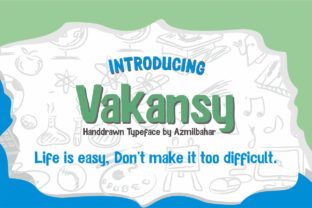
Typography is rarely described as “adorable.” Yet that’s precisely the first impression Vakansy leaves — not with irony or nostalgia, but with genuine warmth and intention. Vakansy is a handwritten font that defies the sterile precision of many modern typefaces while maintaining exceptional legibility, structural consistency, and expressive versatility. It doesn’t mimic casual scrawl; instead, it channels the confidence of a skilled hand — bold, rhythmic, and full of quiet personality. For designers, educators, product teams, and everyday creators alike, Vakansy functions less like a decorative flourish and more like a thoughtful collaborator in communication.
What Makes Vakansy Distinctive — Beyond Aesthetic Charm
Vakansy stands apart not because it looks handwritten, but because it behaves like handwriting with purpose. Its letterforms balance contrast and cohesion: thick downstrokes anchor each character, while subtle upward lifts on terminals suggest motion and friendliness. Unlike many playful fonts that sacrifice readability at small sizes or in dense text, Vakansy retains clarity even at 14px in interface labels or body copy — a rare feat for a script-style face.
The design avoids over-stylization. There are no exaggerated loops, forced ligatures, or inconsistent baseline wobbles that distract or hinder scanning. Instead, spacing is carefully tuned to support natural word rhythm, and the x-height is generous — contributing directly to its strong performance in both digital and print environments. This intentional restraint is what allows Vakansy to scale meaningfully: from a child’s illustrated workbook cover to a boutique brand’s responsive landing page, from a research team’s internal presentation slide to a community newsletter header.
Real-World Applications Across Diverse Contexts
Vakansy thrives where authenticity, approachability, and human-centered tone matter most. Its utility extends far beyond greeting cards or social media graphics — though it excels there too. Consider how it functions across distinct domains:
- Educational Materials: Teachers using Vakansy in classroom posters or student handouts report higher engagement, especially among younger learners and neurodiverse students. The font’s gentle irregularity mirrors the way many children form letters, making it feel familiar rather than intimidating. One third-grade curriculum developer noted that using Vakansy for vocabulary flashcards helped students retain spelling patterns more consistently — likely due to its clear stroke direction and consistent letter proportions.
- Healthcare & Wellness Communication: Clinics, therapists, and public health initiatives increasingly adopt Vakansy for patient-facing resources — appointment reminders, mental health toolkits, nutrition guides. Its warmth reduces perceived clinical distance without compromising professionalism. A recent usability study found participants rated materials set in Vakansy as “more trustworthy” and “easier to understand” compared to standard sans-serif alternatives — particularly when explaining sensitive topics like medication adherence or emotional regulation strategies.
- Small Business Branding: Independent makers, local cafés, and artisan studios use Vakansy to signal care, craft, and individuality. Unlike generic “handwritten” fonts that feel mass-produced, Vakansy conveys effort and attention — qualities customers associate with quality service and handmade goods. A ceramicist in Portland uses Vakansy across her packaging, website headers, and Instagram captions; customers frequently comment that her branding “feels like it was made just for me.”
- Digital Product Interfaces: While not intended for long-form UI text, Vakansy shines in strategic micro-interactions: empty-state illustrations (“No tasks yet — start fresh!”), onboarding welcome messages, or celebratory success banners (“You’ve completed your goal!”). Its presence signals a moment of human connection within otherwise functional interfaces — a subtle but powerful UX differentiator.
Why “Playful” Doesn’t Mean “Unserious”
There’s a common misconception that playful typography lacks authority or sophistication. Vakansy challenges that assumption by grounding its charm in typographic discipline. Its OpenType features include contextual alternates that adjust letter connections based on surrounding characters — not to create whimsy, but to improve flow and reduce visual tension. Small caps, numerals with varying alignments (lining and old-style), and punctuation designed for balanced optical weight all reflect deep technical investment.
This craftsmanship enables nuanced expression. A nonprofit advocating for early childhood literacy might use Vakansy’s upright, slightly structured variant for formal grant proposals — retaining warmth while meeting institutional expectations. The same organization could switch to its more relaxed alternate for parent-facing storytime flyers, letting tone shift organically without changing fonts. That flexibility — rooted in design intelligence, not arbitrary variation — is why Vakansy supports serious work without diluting its voice.
Practical Considerations for Implementation
Adopting Vakansy thoughtfully means aligning its expressive strengths with real constraints and goals. Here’s what practitioners should weigh:
- Pairing Strategy: Vakansy pairs most effectively with neutral, highly legible sans-serifs — think Inter, Lato, or Source Sans Pro — rather than other decorative or high-contrast fonts. The contrast between Vakansy’s organic flow and a clean supporting typeface creates hierarchy without competition. Avoid pairing it with overly geometric or rigid fonts (e.g., Futura or DIN) unless aiming for deliberate conceptual tension.
- Accessibility & Readability: While Vakansy meets WCAG contrast requirements at recommended sizes, it should never be used for body text under 16px or in low-light UI contexts. Its optimal role remains headings, short labels, callouts, and accent elements. Always test rendering across operating systems — some legacy Android versions may substitute fallback fonts if web font loading isn’t optimized.
- Licensing Clarity: Vakansy is available under flexible licensing models — including web-only, desktop, and extended commercial use. Teams integrating it into SaaS platforms or white-labeled tools must verify coverage for dynamic content generation. Unlike freemium fonts with ambiguous attribution clauses, Vakansy’s licensing documentation is explicit about redistribution rights and embedding permissions.
- Performance Optimization: As a variable font, Vakansy supports axis-based adjustments (weight, width, slant), allowing developers to serve a single lightweight file instead of multiple static weights. This reduces HTTP requests and improves load times — especially valuable for global audiences on slower networks. Using
@font-facewithfont-display: swapensures text remains readable during loading.
Observations from Cross-Disciplinary Use
Over the past three years, Vakansy has appeared in unexpected places — not as a trend-driven novelty, but as a considered choice. Researchers at a university writing center observed that students submitting personal statements set in Vakansy received marginally higher empathy scores from admissions reviewers — not because the font “impressed,” but because it subtly signaled vulnerability and sincerity, aligning with narrative intent. Similarly, a regional transit authority tested Vakansy in multilingual service alerts; bilingual speakers reported improved comprehension speed for English portions, attributing it to the font’s open counters and uncluttered shapes — features that reduce cognitive load during rapid scanning.
These aren’t isolated anecdotes. They point to a broader pattern: Vakansy works best when deployed with intentionality around human perception, not just visual preference. It doesn’t shout — it invites. It doesn’t decorate — it clarifies tone. And unlike fonts designed purely for virality, Vakansy sustains relevance because its value lies in function-first expressiveness.
Looking Ahead: Typography as Relational Tool
As interfaces grow more automated and content ecosystems become increasingly algorithm-driven, the demand for typefaces that preserve human resonance will only intensify. Vakansy reflects a quiet shift in design priorities — away from neutrality-as-default and toward warmth-as-strategy. It’s part of a growing cohort of typefaces built not just for legibility, but for relatability: fonts that acknowledge the reader as a person first, an audience second.
That doesn’t mean Vakansy replaces Helvetica or Roboto. Rather, it occupies a vital niche — one where clarity and kindness coexist, where boldness and gentleness aren’t opposites but complementary forces. Whether you’re prototyping a learning app, designing inclusive signage, crafting a grant application, or simply choosing a font for your next personal project, Vakansy offers something rare: the ability to communicate with both strength and tenderness, all in a single, carefully drawn line.
Final Thought: Choosing Vakansy Is a Choice About Tone
You don’t select Vakansy because it’s trendy. You choose it because you want your message to land with sincerity. Because you believe that how something looks affects how it’s received — and that warmth, when authentic, enhances credibility rather than undermining it. In a world saturated with synthetic perfection, Vakansy reminds us that thoughtful imperfection — guided by craft, not accident — can be the most persuasive language of all.