Great Things: When Handwritten Authenticity Meets Design Confidence
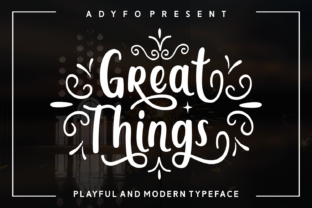
Typography isn’t just about legibility—it’s about resonance. In a digital landscape saturated with geometric sans-serifs and algorithmically optimized fonts, Great Things stands apart not by shouting, but by leaning in with quiet, unmistakable character. It’s a classic handwritten font with an authentic twist: not a scan of someone’s diary scrawl, nor a sterile simulation of calligraphy—but a thoughtfully crafted typeface that preserves the warmth of human gesture while delivering the reliability designers and developers need for real-world implementation.
The Anatomy of Authenticity
What makes Great Things feel genuinely handwritten—and why does that matter? Unlike many “script” fonts that rely on rigid alternates or predictable ligature patterns, Great Things integrates subtle variation at the foundational level. Letterforms shift slightly in weight, slant, and terminal shape—not randomly, but with intention. The lowercase “a” might appear in two distinct but harmonious forms across a paragraph; the “s” carries a gentle upward flick in one instance and a grounded, looping finish in another. These aren’t decorative flourishes added after the fact—they’re baked into the design system, mimicking how a person naturally writes the same word twice without identical strokes.
This authenticity isn’t nostalgic—it’s functional. Research in cognitive psychology shows that moderately irregular, human-like visual stimuli improve recall and emotional engagement without compromising comprehension. In practice, that means a headline set in Great Things doesn’t just look friendly—it invites pause, builds trust, and lingers in memory longer than its perfectly uniform counterparts.
Where Human Texture Adds Real Value
Authentic handwriting aesthetics thrive where credibility and connection are paramount—especially when automation feels overbearing. Consider these high-impact use cases:
- Brand Voice Anchoring: A sustainable skincare startup uses Great Things for its ingredient storytelling—“cold-pressed jojoba oil, harvested at dawn”—set beside clinical photography. The contrast grounds technical content in care and craft, reinforcing transparency without sacrificing sophistication.
- Educational Materials: University faculty designing open-access STEM modules apply Great Things to conceptual annotations—e.g., margin notes explaining why a physics equation behaves differently under friction. Students report higher retention of annotated explanations versus plain-text versions, citing the “teacherly” tone it conveys.
- Community-Centered Interfaces: Local libraries and neighborhood co-ops integrate Great Things into event banners and volunteer sign-up cards. Users consistently describe the typography as “approachable but not childish,” lowering perceived barriers to participation—especially among older adults and non-native speakers who associate rigid fonts with bureaucracy.
- Printed Artifacts with Digital Echoes: Wedding invitations, artisanal product labels, and limited-run zines gain tactile credibility when set in Great Things. Crucially, its OpenType features support web embedding without fallback distortion—so the same warmth appears in email RSVPs or online store listings, preserving brand continuity across touchpoints.
Technical Strength Beneath the Surface
Authenticity without utility is decoration. What distinguishes Great Things from novelty fonts is its engineering rigor. It ships with full Latin-1 support, robust kerning pairs for common English digraphs (like “th”, “ou”, and “ie”), and carefully tuned spacing metrics that prevent awkward gaps in headings or tight lines in body copy. Its x-height sits deliberately mid-range—not so tall that it feels cartoonish, not so low that it sacrifices readability at smaller sizes.
Developers appreciate its lightweight WOFF2 build (<32 KB) and seamless CSS integration. No complex variable axes to configure—just clean font-family: "Great Things", cursive; with graceful browser fallbacks. And because it avoids extreme stroke contrast or ultra-thin hairlines, it renders crisply even on lower-DPI screens and older e-ink devices—critical for accessibility-conscious projects like educational apps or civic information portals.
Who Benefits—and How They Use It Differently
Design decisions ripple across disciplines. Here’s how diverse practitioners leverage Great Things with distinct priorities:
Small Business Owners
For service-based entrepreneurs—a yoga instructor, a home renovation consultant, a freelance bookkeeper—the font signals approachability without underselling expertise. One financial advisor uses Great Things exclusively for client welcome packets and quarterly review summaries. “Clients tell me the documents feel ‘hand-signed,’ even though they’re digital,” she notes. “It softens the anxiety around money talk.”
Educators & Curriculum Designers
In blended learning environments, Great Things serves as a visual cue for “human voice” moments—teacher commentary, reflection prompts, or empathy-driven instructions (“Take three breaths before starting this exercise”). It creates a consistent typographic hierarchy: system fonts for data and structure, Great Things for guidance and relationship-building.
UX Writers & Content Strategists
Rather than defaulting to script fonts for “personality,” forward-thinking teams deploy Great Things strategically—to soften error messages (“Oops! Let’s try that again”), highlight user-generated content badges (“Your note, handwritten-style”), or distinguish community guidelines from platform terms. Its restraint prevents tonal whiplash in complex interfaces.
Hobbyists & Makers
From laser-cut greeting cards to embroidered tote bag designs, Great Things scales beautifully across physical media. Its generous counters (the enclosed spaces in letters like “e” or “a”) resist filling in during vinyl cutting or screen printing. Hobbyists report fewer test runs and cleaner final outputs—proof that thoughtful typography supports craft at every stage.
Thoughtful Implementation: Beyond Aesthetics
Using Great Things effectively requires attention to context—not just contrast and color, but cognitive load and cultural framing. A few evidence-informed considerations:
- Avoid overuse in dense text: While highly legible at 18–24px for headings and short blocks, extended reading (e.g., blog posts >300 words) benefits from pairing Great Things with a neutral, highly readable companion face like Lora or Inter. This follows established typographic best practices for mixed-font rhythm.
- Respect linguistic nuance: Though designed for English, its letterforms accommodate common accented characters used in Spanish, French, and German. However, extended diacritical marks (e.g., Polish “ł” or Vietnamese tone marks) may require manual adjustment or supplemental web fonts—always test with real multilingual content.
- Consider motion and interaction: In animated interfaces, subtle letter-shape morphing using Great Things’s alternate glyphs can reinforce transitions—e.g., a “Submit” button transforming into a checkmark icon via glyph substitution. This leverages the font’s built-in OpenType features rather than relying on JavaScript-heavy solutions.
- Accessibility alignment: Its clear letter differentiation (e.g., distinct “I”, “l”, and “1”) and moderate stroke variation meet WCAG 2.1 contrast recommendations against light and dark backgrounds. Always verify contrast ratios using tools like axe or WebAIM when custom colors are applied.
Why This Font Endures—Beyond Trend Cycles
Handwritten fonts rise and fall with design trends, but Great Things avoids trend dependency through deliberate balance. It doesn’t mimic chalkboard scrawls or fountain-pen extravagance—instead, it captures the confident, unhurried hand of someone writing with purpose and presence. That quality translates across eras: a 2024 nonprofit campaign and a 2032 archival exhibition catalog both find resonance in its measured irregularity.
More importantly, it answers a quiet but growing need: digital experiences that acknowledge human limitation and intention. In an age of AI-generated text, auto-tuned voices, and predictive interfaces, choosing Great Things is a small but meaningful act of human-centered design—one that says, “This was made with attention. You are seen.”
Getting Started—Without Overcomplication
You don’t need advanced typography training to begin. Start with one intentional application:
- Pick a single high-visibility element—your newsletter subject line, your portfolio’s “About Me” header, or the tagline on your product landing page.
- Set it in Great Things at 28–36px, with generous line height (1.4–1.6) and ample letter-spacing (0.5–1.0px) to let the forms breathe.
- Pair it with a simple, well-spaced sans-serif (like Poppins or Source Sans Pro) for supporting text—no more than two typefaces total.
- Test across devices: Does it retain warmth on a mobile screen? Does it still feel intentional when scaled down in a notification banner?
If it feels cohesive—not cute, not forced, but quietly confident—you’ve found your entry point. From there, expand deliberately: a testimonial quote, a workshop title, a chapter divider in a self-published guide. Each use reinforces the voice you’re cultivating—not through repetition, but through consistency of intent.
Ultimately, Great Things isn’t about adding “personality” as an afterthought. It’s about recognizing that the most enduring creative work—the kind that moves people, clarifies ideas, and builds trust—carries the subtle, irreplaceable signature of human care. And sometimes, that signature begins with a single, well-chosen letterform.