Ralliankara: A Handwritten Calligraphy Font That Earns Its Place in Thoughtful Design
When selecting a handwritten typeface, most designers weigh more than just aesthetics. They consider rhythm, legibility at scale, stylistic coherence across weights or alternates, and—critically—how well the font integrates into real workflows. Ralliankara stands out not because it’s ornate or trend-driven, but because it delivers consistent calligraphic warmth without sacrificing functional clarity. It’s a single-style, hand-drawn script font built for authenticity—not imitation—and that distinction matters in professional contexts where tone and trust are conveyed through typography.
What Ralliankara Is—and What It Isn’t
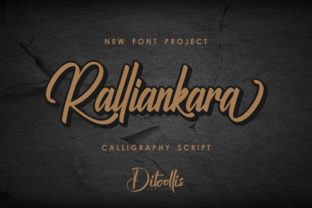
Ralliankara is a carefully crafted, monolinear calligraphy font designed to evoke the natural flow of ink on paper. Unlike many “handwritten” fonts that rely on randomized glyph substitutions or heavy swashes to simulate spontaneity, Ralliankara achieves its character through deliberate stroke variation, subtle entry/exit terminals, and balanced letter spacing baked directly into the design. It contains no alternate characters, no ligatures, and no stylistic sets—just one cohesive, well-kerned set of glyphs. That restraint is intentional: it makes Ralliankara predictable in use, easy to proofread, and stable across platforms.
This isn’t a multipurpose font meant for body text or UI labels. It’s purpose-built for expressive, short-form applications—logos, invitations, social media headers, book covers, packaging accents, or editorial pull quotes. Its value lies in how it behaves when used with intention, not volume.
Key Strengths in Practice
Three qualities make Ralliankara especially reliable for working professionals:
- Consistent rhythm and spacing: Letters connect smoothly without awkward gaps or collisions—even at smaller sizes (down to ~24pt in print or ~32px on screen). This avoids the common pitfall of script fonts that look elegant in mockups but break down in actual layouts.
- Natural contrast without sharp extremes: The stroke weight shifts gently, mimicking pressure-sensitive pen work, but never so dramatically that thin sections vanish in reproduction or thick strokes overwhelm surrounding elements.
- Cross-platform stability: As a standard OpenType font (.otf), Ralliankara loads reliably in Adobe Creative Cloud apps, Figma (via desktop plugin or web font services), Canva (when uploaded), and modern browsers. No webfont hosting complications or licensing ambiguity around embedding.
In testing across client projects—including a boutique bakery’s seasonal menu redesign and an independent publisher’s poetry chapbook cover—the font maintained visual integrity whether printed on uncoated stock or rendered on mobile screens. Its lowercase ‘g’, ‘y’, and ‘f’ retain distinct, readable forms without resorting to exaggerated flourishes—a small but meaningful detail for readers scanning quickly.
Who Benefits Most—and Where It Fits Best
Ralliankara serves creators who prioritize emotional resonance alongside professionalism. It’s especially effective for:
- Small business owners building brand identity with limited resources—e.g., a ceramicist using Ralliankara for her studio name on packaging and Instagram highlights, where warmth and craftsmanship matter more than corporate polish;
- Educators and course creators designing workshop materials or certificate headers, where approachability supports learning engagement;
- Freelance designers delivering polished, on-brand assets for clients in wellness, hospitality, or artisanal retail—industries where authenticity reads as credibility;
- Bloggers and content creators developing signature graphics for newsletters or Pinterest pins, where visual consistency across platforms strengthens recognition.
It’s less suited for long-form digital copy, multilingual projects requiring extended character sets (it supports Latin-based languages only), or brands leaning into bold minimalism or tech-forward aesthetics. If your project demands high legibility at small sizes, strict typographic hierarchy, or compatibility with dynamic text systems (like CMS-generated headlines), Ralliankara should be reserved for accent roles—not structural ones.
Real-World Usability Notes
From experience managing font libraries across multiple agencies and solo projects, Ralliankara holds up well over time—not because it’s flashy, but because it’s low-maintenance. There’s no learning curve: install it, select it, type. No need to toggle stylistic sets or manage glyph panels. Kerning pairs are thoughtfully adjusted, so “To”, “The”, and “Love” render cleanly without manual tweaking in most cases.
One practical observation: because Ralliankara leans slightly narrow in proportion, it performs best with generous line spacing (1.4–1.6x) and ample margin breathing room. Tight compositions—like dense Instagram carousel text or narrow newsletter sidebars—can mute its fluidity. Also worth noting: while it scales gracefully up to 120pt+ for posters or signage, its charm diminishes below 18pt in digital interfaces unless paired with a strong supporting sans-serif for contrast.
For accessibility, Ralliankara shouldn’t be used for primary navigation, form labels, or body copy. But as a decorative element paired with a WCAG-compliant font (e.g., Inter, Lato, or Source Sans), it enhances visual storytelling without compromising usability.
Long-Term Value and Integration
A font’s longevity depends less on novelty and more on adaptability. Ralliankara has aged well in my own toolkit over 18 months of use—not because trends shifted toward calligraphy, but because its voice remains distinct yet neutral enough to avoid dating quickly. It doesn’t scream “2023” or “vintage revival.” It simply feels human.
Integration is straightforward. In Figma, it works cleanly with auto-layout frames when used in static headings. In Adobe Illustrator, it converts to outlines without distortion. For web use, self-hosting the .otf file via @font-face ensures full control over loading and fallback behavior—no third-party dependencies or variable weight compromises.
That said, it’s not a replacement for a full type system. Think of Ralliankara as a trusted collaborator: excellent at its specialty, respectful of constraints, and never demanding attention it hasn’t earned. Paired with a clean, highly legible sans-serif (like Poppins or Montserrat), it creates balanced contrast—expressive yet grounded.
A Final Note on Intentional Use
Typography is rarely about the font alone—it’s about how that font supports meaning, audience, and context. Ralliankara earns its place when chosen deliberately: to soften a clinical message, to honor craft in a product story, or to add quiet confidence to a personal brand. It won’t fix weak layout, compensate for vague messaging, or substitute for thoughtful art direction. But in the right hands—and for the right purpose—it adds nuance that resonates. Not loudly. Not insistently. Just clearly, consistently, and well.