Flower Adaline: Where Handwritten Charm Meets Modern Design
There’s something quietly magnetic about fonts that feel like they were written by hand—not with a steady, mechanical rhythm, but with breath, hesitation, and gentle lift of the pen. Flower Adaline is one of those rare typefaces that captures that human warmth without sacrificing clarity or versatility. It’s not just another script font; it’s a delicate balance of youthfulness and quiet elegance—light enough for airy layouts, refined enough for high-end branding.
A Font That Breathes
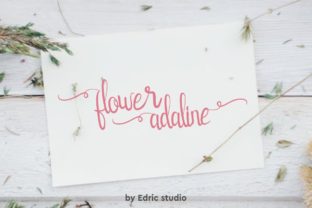
At first glance, Flower Adaline feels effortlessly graceful. Its lowercase letters flow with subtle variation in stroke weight, soft terminals, and slight upward tilt—like ink drying just so on textured paper. There are no harsh angles or rigid curves. Instead, each character carries a whisper of spontaneity: the “a” has a tender loop, the “g” curls with modest confidence, and the “y” descends with a gentle, unhurried sway. This isn’t calligraphy imitating perfection—it’s calligraphy embracing personality.
What makes Flower Adaline especially effective is its restraint. Unlike many handwritten fonts that lean into dramatic flourishes or dense blackletter energy, Flower Adaline keeps things open, airy, and legible—even at smaller sizes. Its x-height is generous, spacing is thoughtfully generous, and baseline consistency gives it surprising stability in body text applications.
Where Flower Adaline Fits Naturally
You’ll find Flower Adaline thriving where authenticity meets intentionality. It’s become a favorite among designers working with lifestyle brands, boutique studios, wedding stationers, and mindful wellness creators—all spaces where tone matters as much as typography.
- Wedding suites: Invitations, menus, and signage gain instant warmth when set in Flower Adaline—especially paired with minimalist sans-serif companions like Montserrat or Lora for contrast.
- Small-batch product packaging: Think artisanal teas, handmade candles, or organic skincare. The font’s lightness mirrors the care behind the craft—never overwhelming, always inviting.
- Digital storytelling: Blogs focused on slow living, journaling, or creative entrepreneurship use Flower Adaline for pull quotes, headings, or even custom email headers—adding visual texture without slowing down page load.
- Social media visuals: Instagram quote cards, Pinterest pins, or Canva templates benefit from Flower Adaline’s ability to stand out in feeds while feeling intimate and personal.
It’s worth noting: Flower Adaline works best when it’s given room to breathe. Crowding it with dense blocks of text or pairing it with overly ornate companions dilutes its charm. Its strength lies in contrast—in being the soft voice in a composition full of structure.
Practical Considerations Before You Use It
Before downloading or licensing Flower Adaline, consider how—and where—you plan to apply it. Here’s what seasoned designers keep in mind:
- Licensing scope: Check whether your intended use (e.g., client work, merchandise, web embedding) is covered. Some versions allow unlimited commercial use; others require extended licenses for app integration or SaaS platforms.
- File formats: Flower Adaline typically ships in OTF and TTF. For web use, ensure you have WOFF2 support or access to a reliable font-hosting service. Self-hosting gives more control over loading performance.
- Language support: While Flower Adaline covers Latin-based languages comprehensively—including accented characters for French, Spanish, and German—it doesn’t include Cyrillic or Arabic glyphs. If your audience spans multilingual markets, verify coverage early.
- Pairing strategy: Avoid pairing with other script fonts. Instead, choose a clean, neutral sans-serif (like Inter or Poppins) or a refined serif (such as Playfair Display or Cormorant Garamond) to ground the composition. A good rule? Let Flower Adaline speak first—then let the supporting type listen.
Why Designers Reach for Flower Adaline Again and Again
It’s not just aesthetics. There’s real functional value in choosing a font like Flower Adaline. In an era saturated with bold, geometric, and AI-generated type, this font offers emotional resonance. Studies in design psychology suggest that handwritten-inspired typefaces increase perceived trustworthiness and approachability—particularly in contexts tied to care, creativity, or personal growth.
Think about it: When someone sees a wellness coach’s website using Flower Adaline in their headline, they don’t just read the words—they register a feeling: calm, intentional, human. That subconscious cue builds connection faster than any tagline ever could.
And because Flower Adaline avoids trend-chasing extremes—no exaggerated swashes, no forced irregularity—it ages gracefully. A brand identity built around it today will still feel fresh two, even five years from now. That longevity translates directly into cost savings: fewer redesigns, less rebranding fatigue, stronger recognition over time.
Real-World Usage Tips
Here’s how professionals get the most out of Flower Adaline without overcomplicating things:
- Use optical sizing wisely: If your version includes multiple weights or optical variants, opt for lighter cuts for large display sizes (e.g., hero banners), and slightly bolder ones for mid-size headings—this prevents hairline strokes from disappearing on screens.
- Adjust tracking intentionally: Default letter-spacing often feels too tight for Flower Adaline. Add 20–40 units of tracking in design tools like Figma or Adobe Illustrator to honor its natural rhythm.
- Limit usage to key moments: Reserve Flower Adaline for headlines, logos, or short phrases—not long paragraphs. Its beauty shines brightest when it’s purposeful, not pervasive.
- Test across devices: Preview how it renders on mobile Safari and Android Chrome. Some handwritten fonts suffer from hinting issues on older Android versions—Flower Adaline generally performs well, but always verify with real content.
More Than Just a Pretty Face
What separates Flower Adaline from passing trends is its thoughtful construction. Every curve was drawn—not algorithmically generated. Every alternate glyph (like the stylistic “&” or swash “t”) serves a compositional purpose, not just decoration. It’s the kind of font that rewards close attention: zoom in, and you’ll notice micro-variations in stroke endings, subtle ink bleed effects, and consistent pressure simulation that mimics real pen-on-paper behavior.
That level of craftsmanship makes it adaptable beyond static layouts. Animators use Flower Adaline in motion graphics for handwritten reveal effects. Lettering artists trace over it as a base for custom illustrations. Even educators incorporate it into printable worksheets for handwriting practice—its natural rhythm helps learners internalize letterform flow without rigid rigidity.
In short, Flower Adaline isn’t just a tool for making things look pretty. It’s a bridge between digital precision and human expression—a reminder that even in our fastest-moving workflows, there’s space for slowness, sensitivity, and signature style.