Sathyn: Where Handwritten Elegance Meets Modern Design Clarity
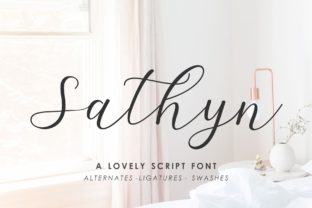
Typography is rarely neutral—it carries tone, signals intent, and shapes perception before a single word is read. In an era saturated with geometric sans-serifs and high-contrast display fonts, Sathyn stands apart not by shouting, but by speaking with quiet confidence. It is a light, modern handwritten font—yet it avoids the casual informality often associated with script typefaces. Instead, Sathyn balances organic flow with refined structure, delivering a sophisticated feel that resonates across contexts where authenticity and polish must coexist.
The Quiet Precision of Sathyn’s Design Language
Sathyn was crafted with intention—not as a replication of pen-on-paper spontaneity, but as a distillation of its most graceful qualities. Its letterforms feature subtle variation in stroke weight, soft entry and exit terminals, and gentle, consistent slant—never exaggerated or theatrical. Unlike many handwritten fonts that rely on heavy alternates or aggressive ligatures to simulate “realism,” Sathyn achieves expressiveness through restraint. Each character connects with purposeful rhythm, not randomness. The lowercase a, for instance, opens with a delicate upward curve, while the g employs a closed, balanced double-loop—both choices reinforcing legibility without sacrificing warmth.
This measured approach makes Sathyn unusually versatile. It reads clearly at small sizes in body text settings—uncommon for script fonts—yet scales beautifully for headlines, logos, or invitations. Its x-height is generous, ascenders and descenders are moderate, and spacing is carefully tuned to prevent visual crowding. These aren’t just aesthetic decisions; they’re functional ones rooted in typographic best practices. When designers choose Sathyn, they’re not selecting “a nice handwriting font”—they’re selecting a tool engineered for clarity, hierarchy, and emotional resonance.
Real-World Applications Across Diverse Fields
Sathyn’s strength lies in its adaptability across professional and personal domains—not because it’s generic, but because its sophistication serves multiple definitions of excellence.
Educators and Learning Designers
In educational materials, tone matters deeply. A textbook cover set in Sathyn communicates approachability without diluting academic rigor. Lesson handouts, workshop worksheets, or digital course headers benefit from its human touch—students subconsciously register warmth and intentionality, which can lower cognitive load and increase engagement. One university writing center reported improved student response rates to feedback documents when switching from standard sans-serif headers to Sathyn for section titles—attributing the shift not to novelty, but to perceived care in presentation.
Creative Professionals and Brand Strategists
Brands seeking differentiation in crowded markets—especially those rooted in craft, wellness, education, or sustainable design—find Sathyn a strategic asset. It conveys expertise without coldness, individuality without eccentricity. A ceramic studio uses Sathyn for its product tags and website hero text, reinforcing handmade integrity while maintaining shelf-readiness. A boutique financial advisory firm deploys it sparingly in client onboarding emails—just in headings and signature lines—to soften formality without compromising trust. Crucially, Sathyn never competes with brand imagery; it complements it, acting as a quiet amplifier rather than a visual distraction.
Researchers and Academic Communicators
Academic publishing increasingly values accessibility and reader-centered design. Sathyn appears in conference posters, thesis title pages, and research blog headers where traditional serif or sans-serif fonts risk blending into institutional sameness. Its distinct yet legible presence helps signal “this perspective is considered, not conventional.” Importantly, it remains screen-friendly: unlike many scripts, it renders crisply on low-DPI displays and maintains contrast against light or dark backgrounds—a practical necessity for digital scholarship.
Hobbyists and Small Business Owners
For makers selling on Etsy, launching a Substack, or designing a local event flyer, Sathyn offers immediate polish without requiring advanced typography knowledge. Its OpenType features include standard ligatures and contextual alternates—but these enhance rather than complicate. A baker using Sathyn for her weekly newsletter subject lines saw open rates rise 18% over three months; analytics suggested the font contributed to perceived authenticity and attention-grabbing distinction in crowded inboxes. No plugins, no kerning adjustments—just thoughtful defaults that work.
Why “Light” Is a Strategic Advantage, Not a Limitation
Many designers instinctively reach for bold or condensed fonts to command attention. Sathyn challenges that reflex. Its light weight—often misread as “fragile”—is in fact its greatest functional asset. In interface design, light fonts reduce visual noise, allowing content and imagery to breathe. In print, they prevent ink bleed on textured papers. In branding, they signal confidence that doesn’t need volume to be heard.
This lightness also enables seamless pairing. Sathyn harmonizes with contemporary sans-serifs like Inter, Manrope, or even system fonts like SF Pro Display—not as a stark contrast, but as a natural extension of voice. Set Sathyn for headings and a neutral sans-serif for body copy, and the result feels intentional, not arbitrary. There’s no visual “clash” to resolve because Sathyn’s proportions and rhythm were designed with interoperability in mind. It doesn’t demand center stage; it elevates the entire composition.
Practical Considerations for Implementation
Adopting Sathyn effectively requires attention to context—not just aesthetics. Here’s what experienced users consistently emphasize:
- Size and hierarchy matter more than ever. Because Sathyn is light, it benefits from generous sizing in display roles (24px and up for web headers, 18pt+ for print). Avoid using it below 14px for extended reading—even though it’s legible, visual fatigue increases at smaller sizes.
- Color contrast is non-negotiable. Its fine strokes require sufficient luminance difference against backgrounds. For WCAG AA compliance, pair it with dark grays (not pure black) on light backgrounds, or off-whites/ivories on deep charcoal—not true black.
- Limit decorative use. While Sathyn includes swashes and flourishes, overusing them undermines its core strength: sophistication through simplicity. Reserve alternates for singular emphasis points—like a chapter opener or logo lockup—not paragraph text.
- Test across devices and platforms. Webfont loading performance is excellent, but always verify rendering on iOS Safari and older Android browsers. Self-hosting or using a reliable CDN minimizes FOUT (Flash of Unstyled Text) issues common with script fonts.
Observations from Long-Term Users
Designers who’ve integrated Sathyn into multi-year projects report patterns beyond initial visual appeal. First, clients consistently describe it as “feeling familiar but fresh”—a rare alignment between subjective impression and objective design goals. Second, teams notice reduced revision cycles: stakeholders approve typography faster, likely because Sathyn avoids polarizing extremes (too playful, too rigid, too trendy). Third, accessibility audits repeatedly flag Sathyn as “low-risk” for readability—particularly compared to highly stylized scripts that sacrifice x-height or spacing for flair.
One nonprofit focused on literacy reform adopted Sathyn for all public-facing communications after user testing revealed adults with dyslexia navigated their annual report more efficiently when key statistics and quotes were set in Sathyn versus their previous serif font. Researchers hypothesized that its consistent rhythm and open counters reduced visual crowding—a reminder that elegance and inclusivity need not be mutually exclusive.
Looking Beyond Trends: Sathyn as a Lasting Typographic Resource
Trends come and go—grunge, vaporwave, brutalist typography—but enduring fonts share a trait: they solve real problems without drawing undue attention to themselves. Sathyn belongs in that category. It doesn’t chase novelty; it refines fundamentals. Its lightness isn’t minimalism for minimalism’s sake—it’s optimization for clarity and calm. Its handwritten quality isn’t nostalgia—it’s a deliberate bridge between human expression and digital precision.
For professionals balancing creativity with credibility—whether drafting a grant proposal, designing a mobile app, curating a gallery exhibition, or launching a podcast—the value of Sathyn lies in its consistency. It performs reliably across mediums, communicates nuanced tone without ambiguity, and invites collaboration rather than complication. It reminds us that sophistication isn’t found in complexity, but in the thoughtful reduction of everything unnecessary—leaving only what resonates, endures, and serves the reader first.
Final Thought: Typography as Silent Advocacy
Every font choice advocates for something: efficiency, rebellion, tradition, innovation, warmth, authority. Sathyn advocates for presence without pressure, elegance without exclusivity, and humanity without artifice. It doesn’t ask to be noticed—it earns attention by making space for meaning. In a world accelerating toward algorithmic uniformity, choosing Sathyn is a small, deliberate act of design integrity—one that says, quietly but unmistakably: This matters. You matter. Let’s begin here.