Teressia Script: Where Handwritten Warmth Meets Modern Design Clarity
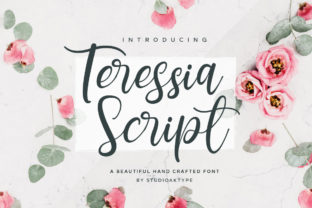
There’s a quiet shift happening in how we communicate visually—not through louder fonts or bolder effects, but through softer intention. Teressia Script stands at the center of that shift: a beautifully handwritten font crafted with natural shades and subtle variation, designed not to shout, but to resonate. It doesn’t mimic calligraphy as performance—it embodies handwriting as presence. Each glyph flows into the next with organic rhythm, carrying the gentle irregularity of ink on paper, the warmth of human touch, and the quiet confidence of thoughtful design.
More Than Aesthetic—A Response to Digital Fatigue
We spend hours scrolling, clicking, and consuming interfaces built for speed, not stillness. As screen time deepens, so does our subconscious craving for authenticity—textures we can almost feel, forms that breathe, typography that feels made, not generated. Teressia Script answers that need without nostalgia or artifice. Its natural shades—soft greys, warm ochres, muted sepia—aren’t just color choices; they’re tonal anchors that ground digital work in something tactile and familiar. Unlike high-contrast sans-serifs optimized for scanning, Teressia invites pause. It slows reading just enough to deepen connection—ideal for brand storytelling, editorial headers, invitation suites, or product packaging where emotional resonance matters more than milliseconds saved.
How Handwritten Typography Fits Into Today’s Creative Workflows
Modern design tools have made custom lettering more accessible—but also more homogenized. Many “hand-drawn” fonts rely on rigid brush presets or uniform stroke weights, sacrificing nuance for convenience. Teressia Script breaks that pattern. Its letterforms include intentional variations in line thickness, slight angle shifts between ascenders and descenders, and carefully calibrated spacing that mimics how a hand naturally moves across a page. That means designers don’t need to manually adjust kerning or add faux texture overlays to achieve realism. It works natively in Figma, Adobe Creative Cloud, and modern web environments—scaling cleanly from mobile UI headers to large-format print—without losing its expressive integrity.
This reliability matters especially for professionals juggling multiple roles: a small-business owner updating their Shopify banner while drafting an Instagram carousel; an educator designing printable worksheets that balance clarity and approachability; a freelance copywriter pairing evocative headlines with clean body text. Teressia Script serves those dual needs—offering personality without compromising legibility, distinction without demanding extra production time.
Real Use Cases Across Roles
- Bloggers & Content Creators: Using Teressia Script for article titles or pull quotes adds visual hierarchy while reinforcing voice—especially effective for lifestyle, wellness, or personal development content where tone is part of the value.
- Educators & Coaches: Worksheets, reflection journals, or course landing pages benefit from its inviting rhythm. Students and clients report higher engagement with materials that feel personally addressed—not algorithmically assembled.
- Small Business Owners: Local cafés, ceramic studios, or boutique wellness practices use Teressia Script on signage, menus, and email headers to reinforce craft and care—qualities customers increasingly associate with trustworthiness in crowded digital spaces.
- Marketers & Brand Strategists: When paired with a neutral sans-serif (like Inter or Manrope), Teressia Script creates contrast that feels intentional, not decorative—helping brands differentiate in feeds saturated with identical geometric type pairings.
Why Natural Shades Matter Now More Than Ever
“Natural shades” isn’t just a stylistic descriptor—it reflects a broader move away from digital maximalism. Think of the rise of muted palettes in UI design, the popularity of unedited photography on social platforms, or the preference for matte over glossy finishes in physical products. Teressia Script’s palette mirrors that ethos: no neon highlights, no artificial shadows, no forced contrast. Its grayscale variants lean into softness—not weakness—and its warmer tones carry the subtlety of aged paper or sun-faded ink. That restraint makes it highly adaptable: it holds up against busy backgrounds, translates well to dark mode interfaces, and avoids visual competition with photography or illustration.
Crucially, these natural shades are engineered—not approximated. Each weight includes harmonized light/dark variants so that “Teressia Light” doesn’t just look thinner, but feels airier; “Teressia Bold” doesn’t just press harder, but grounds more firmly. That attention to perceptual balance means users don’t need advanced typographic knowledge to deploy it effectively.
Evolution, Not Revolution
Handwritten fonts aren’t new—but their purpose has evolved. Early script fonts often leaned heavily into ornate flourishes or rigid monoline structures, limiting usability. Then came the “brush script” wave—energetic but sometimes chaotic, difficult to scale or pair. Teressia Script represents a maturation: less about imitating tools (fountain pen, marker, chalk) and more about capturing gesture—the lift, the pause, the slight hesitation before a curve begins. That evolution aligns with how professionals now think about branding: not as fixed assets, but as living expressions shaped by context, audience, and medium.
It also reflects changing expectations around accessibility. While highly stylized scripts can challenge readability for some users, Teressia Script maintains clear letterform distinctions—open counters, generous x-height, and consistent baseline alignment—even at smaller sizes. It’s not designed to be universally legible in all contexts (no script font should be), but it respects boundaries: appropriate for headings, quotes, logos, and short-form emphasis—not long paragraphs or data tables. That honesty builds trust with both designers and end users.
Practical Integration—Without Overcomplication
You don’t need to overhaul your entire system to begin using Teressia Script meaningfully. Start small:
- Replace one headline font on your website’s hero section—pair it with a simple, highly readable sans-serif for body text. Notice how the contrast invites focus without overwhelming.
- Use it selectively in email marketing: a single line of Teressia Script in your subject line preview (if supported) or as the opening phrase of your newsletter can increase open rates by signaling human authorship amid automated feeds.
- Apply it to downloadable resources—PDF checklists, planning templates, or workshop handouts. The warmth encourages printing, annotation, and reuse—behaviors strongly correlated with deeper learning and retention.
- Test it in motion: animate a Teressia Script word reveal in a short video intro. Its natural flow translates elegantly to kinetic typography, avoiding the stiffness common with geometric fonts.
Importantly, Teressia Script performs well across platforms. It’s available in OpenType-SVG and variable font formats, supporting color glyphs and responsive weight shifts. For developers embedding it via Google Fonts or self-hosting, fallback stacks remain straightforward—no complex CSS overrides needed.
A Font That Grows With Your Intent
Teressia Script doesn’t promise viral reach or instant conversion. What it offers is quieter leverage: the ability to signal care in a single line of text, to soften a transactional interface, to make information feel offered rather than delivered. In a landscape where attention is fragmented and trust is earned incrementally, that kind of intentionality compounds. It’s why illustrators choose it for signature lines, why podcasters use it in show notes headers, and why HR teams select it for internal welcome kits—to say, without saying aloud, “This was made for you.”
Its relevance isn’t tied to a trend cycle. It’s rooted in something more durable: our ongoing negotiation between efficiency and empathy, automation and authenticity, speed and significance. Teressia Script doesn’t resist progress—it helps us navigate it with grace.