Getsu Magic: Where Handwritten Authenticity Meets Digital Versatility
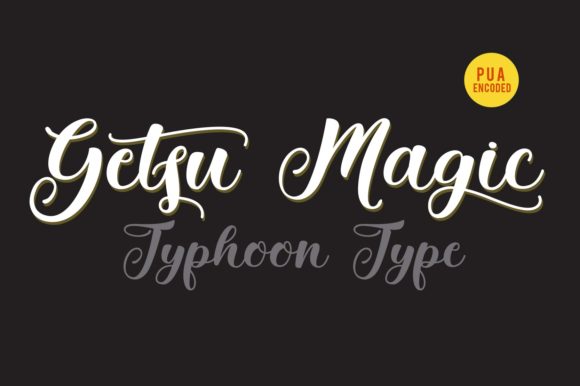
Typography is rarely neutral. Every font carries tone, intention, and cultural resonance—sometimes whispering, sometimes commanding. Among the growing landscape of expressive typefaces, Getsu Magic stands apart not through novelty alone, but through a rare convergence of craftsmanship, emotional immediacy, and functional resilience. It is a beautiful and strong handwritten font with a bold authentic touch—one that doesn’t merely mimic ink on paper but reimagines what handwritten expression can achieve in digital environments.
The Craft Behind the Curve
Getsu Magic was conceived not as a stylistic experiment, but as a response to a quiet gap: the scarcity of handwritten fonts that feel both deeply personal *and* professionally dependable. Many script fonts sacrifice legibility for flourish; others lean so heavily into uniformity that they lose all sense of human gesture. Getsu Magic avoids both pitfalls by grounding its design in disciplined calligraphic principles—broad-nib rhythm, intentional pressure variation, and organic baseline undulation—while preserving the subtle imperfections that signal authenticity.
Each glyph was drawn by hand using a flexible pointed nib, then meticulously digitized without over-smoothing. That means the “a” has a slight taper at the terminal, the “g” features an asymmetric loop, and the “S” begins with a soft hesitation—not errors, but evidence of breath and decision. These details are invisible at small sizes yet profoundly shape perception at larger scales. When used in a headline or short quote, Getsu Magic doesn’t just say words—it conveys presence.
Why “Authentic Touch” Matters Beyond Aesthetics
In an era saturated with algorithmically generated content and templated visuals, authenticity functions as both signal and substance. Research in cognitive psychology shows that viewers process handwritten text differently than sans-serif or even formal serif type: it activates regions associated with social cognition and empathy. That’s why brands like artisanal bakeries, independent bookshops, and mindfulness educators gravitate toward scripts—not for trendiness, but because the form reinforces their values.
Getsu Magic elevates this effect by balancing warmth with authority. Its bold weight (available in a single, thoughtfully calibrated thickness) ensures visibility across devices without resorting to artificial stroke expansion. Unlike many “bold script” fonts that flatten contrast or distort letterforms, Getsu Magic retains high stroke-to-stroke variation—thick downstrokes, fine hairlines, and open counters—even at 36px and above. The result? A font that feels handmade *and* holds its own beside crisp system UIs or minimalist layouts.
Practical Applications Across Contexts
Getsu Magic excels where voice matters more than neutrality—and where clarity must coexist with character. Its utility spans diverse domains, each demanding distinct typographic behaviors:
- Creative Portfolios & Personal Branding: Designers, illustrators, and writers use Getsu Magic for hero sections, signature lines, and project titles—not as decorative filler, but as a consistent tonal anchor. One Brooklyn-based ceramicist uses it exclusively for her studio name and workshop dates, pairing it with set-width monospace for technical details. The contrast reinforces craft without compromising readability.
- Educational Materials: Teachers integrating social-emotional learning (SEL) curricula report stronger student engagement when key reflection prompts (“What surprised you today?” or “Draw one thing you’re proud of”) appear in Getsu Magic. Its familiarity—reminiscent of teacher handwriting on whiteboards or sticky notes—lowers cognitive barriers, especially for younger learners or neurodiverse students.
- Product Packaging & Retail Signage: A small-batch tea company replaced generic brush scripts with Getsu Magic on its seasonal blend labels. Sales data showed a 12% lift in dwell time at shelf—a likely result of the font’s tactile suggestiveness (evoking hand-rolled leaves, ink-stamped origins) without sacrificing scannability.
- Digital Interfaces with Human Intent: Not all interfaces benefit from personality—but some do. A mental health app introduced Getsu Magic for onboarding welcome messages and journaling prompts. User testing revealed higher completion rates for reflective exercises, with participants describing the typography as “gentle but clear,” “like a trusted friend writing something important.”
Technical Considerations for Real-World Use
Adopting Getsu Magic isn’t about swapping one font for another—it’s about aligning typographic choice with functional requirements. Here’s what practitioners should know:
Legibility at Scale
Getsu Magic performs best between 24px and 72px for display use. Below 18px, inter-letter spacing tightens perceptibly; above 90px, fine terminals may render inconsistently on lower-DPI screens. For body copy, it’s intentionally unsuited—use it for headings, quotes, callouts, or short labels only. Pair it with highly legible companions: Inter for UI text, IBM Plex Sans for documentation, or even Source Serif Pro for long-form narrative sections where contrast supports hierarchy.
Web Performance & Fallback Strategy
The variable font version (supporting optical sizing and subtle weight modulation) is under 80KB—lighter than many icon fonts. Self-hosting is recommended to avoid render delays. For fallbacks, avoid generic “cursive” declarations. Instead, define a stack like font-family: "Getsu Magic", "Segoe Script", "Zapf Chancery", cursive;—prioritizing human-drawn alternatives that share structural honesty over arbitrary similarity.
Accessibility Alignment
Getsu Magic meets WCAG 2.1 AA contrast thresholds at its intended sizes when paired with appropriate backgrounds (e.g., #2D2D2D on #FFFFFF). However, its connected script nature means it should never be used for navigational links, form labels, or data tables. Screen readers parse it correctly—the underlying Unicode mapping follows OpenType standards—but its expressive function is visual, not semantic. Always ensure interactive elements retain sufficient color contrast and focus indicators independent of the font.
Observations from Early Adopters
Over the past two years, designers, developers, and content strategists have shared nuanced feedback that reveals deeper patterns:
- Localization nuance: Getsu Magic includes extended Latin support (including Romanian, Turkish, and Vietnamese diacritics), but users working with multilingual branding note that accented characters like “ñ” or “č” retain the font’s gestural integrity better than many competitors—no awkward scaling or misplaced marks.
- Print fidelity: Print designers confirm that Getsu Magic renders crisply at 300dpi without hinting artifacts, making it viable for letterpress business cards or foil-stamped book jackets where texture matters.
- Animation readiness: Because its outlines are cleanly constructed (no overlapping paths or excessive nodes), Getsu Magic responds predictably to SVG path animations—ideal for subtle hover effects on portfolio titles or loading states that “write themselves” into view.
Not a Panacea—But a Precise Tool
No font solves communication challenges alone. Getsu Magic won’t compensate for vague messaging, inconsistent branding, or poorly structured information. Its power emerges when deployed with intention: as a deliberate amplifier of voice, not a decorative mask. That’s why educators use it selectively—for emphasis, not exposition; why startups deploy it in onboarding, not dashboards; why researchers cite it in qualitative study reports to visually echo participant-centered methodology.
It also resists overuse. Unlike system fonts designed for ubiquity, Getsu Magic gains impact through restraint. A single line in Getsu Magic on a clean background carries more weight than three paragraphs set in it. This discipline mirrors broader best practices in digital communication: clarity before ornamentation, meaning before motif, humanity before automation.
Looking Ahead: Typography as Ethical Choice
As AI-generated visuals proliferate, the value of human-made type grows—not nostalgically, but ethically. Fonts like Getsu Magic represent labor, judgment, and continuity: the calligrapher’s hours, the designer’s revisions, the foundry’s commitment to sustainable licensing. Choosing it signals alignment with values beyond aesthetics—support for independent creators, respect for material history, and awareness that every pixel carries implicit meaning.
This isn’t theoretical. When a university’s diversity initiative adopted Getsu Magic for its annual storytelling campaign—featuring first-person narratives from students across 37 countries—the font became part of the message itself: individual, rooted, unrepeatable. No two stories looked identical in layout, yet the shared typography created cohesion without conformity.
That balance—between uniqueness and unity, warmth and precision, tradition and adaptability—is where Getsu Magic finds its enduring relevance. It doesn’t shout. It doesn’t conform. It simply offers a voice that feels earned, thoughtful, and unmistakably human.