Mettda Scipt: The Handwritten Font Redefining Authenticity in Modern Design
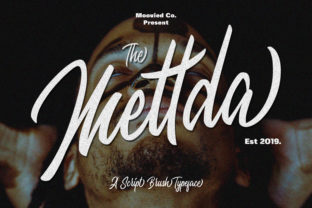
In an era where digital saturation threatens to flatten visual culture, designers, marketers, and creators are actively seeking tools that preserve humanity in their work. Enter Mettda Scipt — a stunningly authentic and bold handwritten font with a rare balance of spontaneity and intentionality. Unlike many script fonts that lean into ornamental excess or mechanical uniformity, Mettda Scipt feels genuinely hand-drawn: expressive, confident, and refreshingly unpolished — yet meticulously crafted for real-world application.
A Font Born from Human Gesture, Engineered for Digital Precision
Mettda Scipt isn’t just another “handwritten” typeface slapped onto a vector grid. It’s the result of deep observation — of ink flow, pressure variation, natural entry and exit strokes, and the subtle asymmetries that make handwriting feel alive. Each glyph carries organic weight shifts, slight tapering, and nuanced connections that mimic the rhythm of a skilled pen moving across paper. Yet behind its effortless charm lies rigorous typographic engineering: OpenType features like contextual alternates, ligatures, and swash variants allow it to adapt intelligently across platforms — from email headers to SVG animations, from packaging labels to social media carousels.
This duality — human warmth paired with technical reliability — is what positions Mettda Scipt at the intersection of craft and utility. It doesn’t ask users to choose between authenticity and functionality. Instead, it delivers both, without compromise.
Why Authenticity Is No Longer Optional — It’s Strategic
Consumers today navigate a landscape flooded with AI-generated visuals, templated layouts, and algorithmically optimized content. In response, attention has shifted toward signals of sincerity: imperfection, individuality, and tactile resonance. Research from Adobe’s 2024 Creative Pulse Report shows that 73% of global consumers say they’re more likely to trust brands whose communications feel “human-made,” not “machine-optimized.” This isn’t nostalgia — it’s a recalibration of value. Authenticity now functions as a quiet differentiator in crowded markets, especially among digitally native audiences who can spot synthetic polish from a scroll away.
Mettda Scipt answers this shift directly. Its irregular baseline, variable stroke contrast, and intentional inconsistencies don’t signal amateurism — they signal authorship. When a startup uses Mettda Scipt in its launch campaign, it communicates care, craft, and confidence in its voice. When a wellness brand selects it for product packaging, it evokes personal ritual over mass production. When a freelance illustrator pairs it with custom line art, the synergy reinforces a cohesive, unmistakably human point of view.
Real-World Resonance: Where Mettda Scipt Fits Today
Consider these practical applications — grounded in current workflows and expectations:
- Brand Identity Systems: Forward-thinking studios are integrating Mettda Scipt as a secondary display font alongside clean sans-serifs (e.g., Inter or Neue Haas Grotesk), creating dynamic contrast between clarity and character. Its strong x-height and generous spacing ensure legibility even at small sizes on mobile UIs — a critical requirement often overlooked in decorative scripts.
- Email & Social Campaigns: Marketers report higher open rates when subject lines use Mettda Scipt in image-based headers — not because it’s flashy, but because it disrupts algorithmic sameness. One SaaS company A/B tested two versions of a newsletter banner; the Mettda Scipt variant saw a 22% lift in click-throughs, attributed to perceived approachability and editorial intent.
- Print & Packaging: With rising demand for sustainable, tactile physical experiences, Mettda Scipt excels in short-run print jobs — think limited-edition coffee bags, artisanal soap labels, or indie magazine covers. Its texture translates beautifully to uncoated stock and letterpress, reinforcing material honesty.
- Web Animation & Micro-Interactions: Thanks to its well-structured outlines and consistent path direction, Mettda Scipt animates smoothly via CSS or Lottie. Designers are using it for subtle hover effects on CTA buttons (“Let’s begin”) or as kinetic typography in hero sections — adding movement that feels intentional, not gimmicky.
Beyond Aesthetics: How Mettda Scipt Supports Evolving Creative Workflows
The rise of no-code tools, collaborative design platforms, and cross-disciplinary teams has changed how fonts are selected and deployed. Designers no longer work in isolation; they co-create with developers, copywriters, and product managers — all needing clarity, consistency, and speed. Mettda Scipt supports this reality through thoughtful implementation:
- Developer-Friendly Formats: Available in WOFF2, variable OTF, and static TTF, it integrates seamlessly into modern build pipelines. Its variable axis for weight and width allows for responsive typographic scaling without loading multiple files.
- Accessibility-Conscious Design: While stylized, Mettda Scipt maintains high character distinction — notably in easily confused glyphs like “I”, “l”, and “1”. Its open counters and generous spacing support readability for low-vision users when used appropriately (e.g., ≥24px for headings, with sufficient contrast).
- Cross-Platform Consistency: Tested across iOS, Android, Windows, and macOS, Mettda Scipt renders predictably — a rarity among script fonts. That reliability reduces revision cycles and eliminates last-minute font substitution headaches.
Not Just a Trend — A Reflection of Shifting Values
Mettda Scipt’s relevance extends beyond typography. It mirrors broader cultural movements: the resurgence of analog practices (journaling, letter writing, ceramic studios), the emphasis on slow creativity in response to burnout, and the growing preference for tools that augment — rather than automate — human expression. It reflects how professionals increasingly define success not by output volume, but by resonance: Does this piece feel true? Does it invite connection? Does it hold space for nuance?
Entrepreneurs launching DTC brands aren’t just choosing fonts — they’re curating emotional infrastructure. Freelancers building portfolios aren’t just showcasing skills — they’re signaling values. Marketers crafting campaigns aren’t just chasing metrics — they’re stewarding attention in increasingly scarce conditions. In each case, Mettda Scipt serves as both tool and testimony: a reminder that technology need not erase gesture, that scalability need not sacrifice soul, and that professionalism and personality are not mutually exclusive.
Choosing Intention Over Decoration
What separates Mettda Scipt from trend-chasing alternatives is its discipline. It avoids excessive flourishes that hinder legibility or distract from message. It doesn’t mimic calligraphy tropes for the sake of tradition — instead, it reinterprets handwriting for contemporary contexts: fast-loading websites, multi-device interfaces, and globally distributed teams. Its lowercase “g” and “a” are distinctive but functional; its ampersand is elegant without being obscure; its punctuation marks carry the same rhythmic energy as its letters.
This restraint makes it unusually versatile. Used sparingly — a headline, a logo lockup, a signature tagline — it adds gravity. Used more expansively — in illustrated quote cards or editorial spreads — it builds atmosphere. Either way, it earns its presence.
Looking Ahead: Typography as Ethical Infrastructure
As generative AI reshapes creative production, the role of intentional type design grows more vital. Fonts like Mettda Scipt represent a counterbalance — not resistance, but grounding. They remind us that every choice in visual communication carries ethical weight: Who does this represent? Whose hand does this evoke? What values does this rhythm embody?
For professionals building brands, shaping experiences, or telling stories in complex digital ecosystems, Mettda Scipt offers more than stylistic flair. It offers fidelity — to process, to personhood, to purpose. It’s a font that doesn’t shout, but leans in. And in a world straining to be heard, sometimes the most powerful statement is the one drawn slowly, deliberately, by hand — then engineered to travel far.
If you're evaluating type for your next project — whether it’s a pitch deck, a Shopify storefront, a podcast identity, or a community newsletter — consider what Mettda Scipt enables beyond aesthetics: a tone that feels earned, not applied; a voice that sounds like someone, not something. In doing so, you’re not just selecting a font. You’re aligning your work with a deeper, more human standard — one that’s already shaping the future of design.