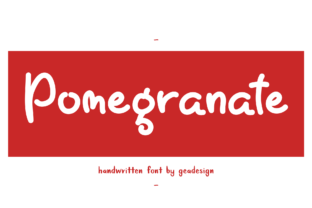
Pomegranate
There’s a quiet shift happening in digital typography—not toward bolder weights or narrower widths, but toward warmth. Toward personality. Toward fonts that don’t just communicate, but connect. Enter Pomegranate: a fun and adorable sans serif font with a unique feel—whimsical without being childish, friendly without sacrificing clarity, and distinctive without demanding attention. It’s not designed to dominate a layout; it’s designed to invite.
A Font That Feels Like a Nod, Not a Shout
Pomegranate stands apart because it resists the current tide of ultra-minimalist, high-contrast, or aggressively geometric sans serifs. Instead, its rounded terminals, gentle curves, and subtly uneven stroke modulation echo hand-drawn charm—yet it renders crisply at any size, from mobile app buttons to printed workshop handouts. Its lowercase “a” and “g” carry a soft double-story shape; its “y” and “j” end in playful, tapered descenders. These aren’t gimmicks—they’re intentional humanizing details that make text feel approachable, especially in contexts where trust and relatability matter most: educational platforms, wellness brands, indie newsletters, children’s learning tools (designed for adults to use), and small-business websites.
Why Whimsy Is Becoming Strategic
It’s not that professionalism is fading—it’s evolving. Users aged 20–50 increasingly respond to authenticity over polish. A 2023 Adobe Creative Cloud survey found that 68% of designers reported clients requesting “more personality” in brand assets, particularly in voice, color, and type. This isn’t about nostalgia or retro trends; it’s about differentiation in saturated digital spaces. When every SaaS dashboard, podcast cover, and Instagram story uses the same handful of neutral fonts, a well-placed, thoughtful choice like Pomegranate signals intention—not just aesthetic preference, but care in how people experience your message.
This aligns with broader shifts: the rise of creator-led businesses that prioritize emotional resonance over corporate sterility; educators building inclusive learning materials where tone affects engagement; marketers crafting email campaigns where open rates hinge as much on visual warmth as subject line copy. Pomegranate doesn’t replace Helvetica or Inter—it complements them. Think of it as the friendly co-host in a duo: Inter handles the body copy and navigation labels; Pomegranate headlines the “Meet Our Team” section, labels a custom illustration series, or animates a micro-interaction on a product page.
From Trend to Tool: How Designers Are Using It Today
Real-world usage reveals practical nuance. A Portland-based language tutor uses Pomegranate for weekly vocabulary cards—its roundness feels encouraging to beginners, and its legibility holds up even when printed on recycled paper. A Berlin-based sustainable skincare startup pairs it with a restrained serif for ingredient lists, letting Pomegranate shine in callouts like “Gentle Enough for Sensitive Skin” or “Made in Small Batches.” A freelance UX writer applies it sparingly in onboarding tooltips—not for all interface text, but for moments where empathy matters most (“You’ve got this!” vs. “Proceed to next step”).
What ties these examples together isn’t whimsy for its own sake. It’s strategic tonal alignment. Pomegranate works because it’s consistent in its character—not distractingly quirky, but reliably kind-eyed. It avoids the pitfalls of many “playful” fonts: no forced bounce, no exaggerated spacing, no inconsistent x-heights. Its rhythm feels natural, not engineered for virality. That restraint is what makes it scalable across touchpoints—from dark-mode app interfaces to embroidered tote bags—without losing coherence.
Accessibility and Authenticity Aren’t Mutually Exclusive
Some assume “adorable” means “less accessible.” Pomegranate challenges that assumption. Its generous x-height, open counters (especially in “e”, “a”, and “s”), and clear letterform distinctions meet WCAG 2.1 AA contrast guidelines when paired with appropriate background colors. Its lowercase “l”, uppercase “I”, and numeral “1” are deliberately differentiated—a small but critical detail for readers with dyslexia or low vision. And because it’s built with variable font technology, developers can adjust weight and width dynamically, improving performance and responsiveness without loading multiple static files.
This bridges two growing priorities: inclusive design and expressive branding. You don’t have to choose between being welcoming and being memorable. In fact, the most enduring brands today—like Duolingo, Mailchimp, or even newer players like Notion’s community templates—are proving that clarity and charm reinforce each other. Pomegranate fits squarely in that space: it communicates without condescension, delights without distraction, and adapts without compromise.
Where It Fits in Modern Workflows
For professionals juggling Figma, Webflow, and Canva, Pomegranate integrates cleanly. It’s available in both desktop and web formats, supports Latin Extended-A (covering most Western European languages), and includes OpenType features like stylistic alternates and ligatures—subtle options, not required ones. A marketer running A/B tests on landing pages might swap headings between Inter and Pomegranate to gauge emotional response in heatmaps or scroll-depth analytics. An educator building a Google Slides curriculum template might use Pomegranate for slide titles and quote callouts, keeping body text in a more neutral option—creating hierarchy through feeling, not just size.
Its versatility extends beyond screens. Print designers appreciate its ink-friendly curves—no hairline stress points that risk filling in on uncoated stock. Motion designers use its consistent metrics to animate letterforms smoothly, whether morphing a headline into an icon or staggering reveal animations across words. Even developers embedding custom fonts via @font-face find its file size lean and its fallback behavior predictable.
A Realistic Note on Adoption
Pomegranate isn’t a universal solution—and it shouldn’t be. It won’t suit legal disclaimers, financial dashboards, or technical documentation where neutrality and precision are paramount. Its strength lies in human-centered contexts: storytelling, relationship-building, learning, and invitation. The most effective users treat it like a strong supporting actor—not the lead in every scene, but unforgettable in the right moment.
That selectivity is part of its authenticity. Choosing Pomegranate signals awareness: awareness of audience, of context, of tone as a functional tool. It reflects a broader maturation in how creators think about typography—not as decoration, but as behavioral design. Every font choice nudges perception, even slightly. Pomegranate nudges toward kindness, curiosity, and calm confidence.
Getting Started Thoughtfully
If you’re considering Pomegranate for your next project, start small. Try it in one high-impact area: a newsletter header, a testimonial banner, or the title of a downloadable guide. Compare how it changes the perceived warmth of the same content set in a standard system font. Notice where it enhances clarity—and where it might soften urgency unnecessarily. Pair it intentionally: with muted, earthy palettes for sustainability work; with crisp whites and soft blues for education; with warm greys and terracotta for artisanal brands.
And remember: its whimsical charm isn’t about escaping reality—it’s about honoring the human behind the screen. In a world of algorithmic feeds and automated replies, choosing a font like Pomegranate is a quiet act of intention. It says, “I see you. I want this to feel good to read.” That’s not fluff. It’s function—with feeling.