The Champ Font
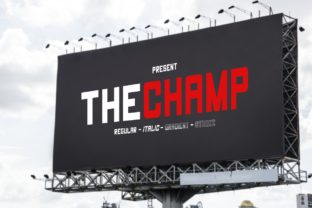
If you’ve ever stared at a blank layout and thought, “This needs more energy—more presence—without looking forced,” The Champ is likely the answer you didn’t know you were searching for. It’s not just another sans serif font. It’s a modern, beautifully balanced display typeface with subtle sporty confidence—clean lines, generous x-height, and just enough dynamic tension in its letterforms to feel alive on screen or paper.
A Font That Moves Without Moving
The Champ sits comfortably in the premium font category: designed with intention, not algorithmic trends. Its sans serif structure gives it versatility, but its personality comes from thoughtful details—slightly tapered terminals, open apertures, and a rhythmic contrast between sturdy verticals and fluid curves. Think of it as the kind of typeface that would look equally at home on a limited-edition sneaker box, a boutique fitness studio’s website banner, or the cover of an indie sports magazine.
It’s not aggressive. It’s not cold. It’s engaged. That’s rare. Many modern sans serifs prioritize neutrality over character; The Champ embraces both. Its lowercase ‘a’ and ‘g’ have a relaxed, confident stance. The uppercase ‘R’ has a decisive leg—not too sharp, not too soft. Even spacing feels intentional, supporting readability without sacrificing impact.
Where The Champ Actually Shines (and Where It Doesn’t)
This isn’t a workhorse body text font—and it shouldn’t be treated as one. The Champ is first and foremost a display font: built for headlines, logos, posters, social media graphics, packaging design, and editorial design moments where you need immediate visual recognition and emotional resonance.
- Logo design: Works exceptionally well for brands with active, aspirational, or community-driven values—think local gyms, wellness studios, youth sports leagues, or lifestyle apparel labels.
- Social media graphics: Stands out in feeds without relying on heavy effects. Its clarity holds up even at smaller sizes on mobile thumbnails.
- Packaging design: Gives products shelf presence—especially when paired with a clean, minimalist secondary font for ingredient lists or descriptions.
- Web design headers: Loads quickly (if served properly), scales cleanly, and reinforces tone before a visitor reads a single word.
It’s less effective for long-form web copy, dense reports, or legal disclaimers. Not because it’s poorly designed—but because its strengths lie in emphasis, not endurance. Using it for body text would dilute its impact and risk legibility fatigue.
How It Shapes Perception—Without Saying a Word
Typeface choice is one of the quietest yet most powerful brand signals you send. The Champ subtly tells your audience: “We’re current, capable, and grounded—but we also care about craft.” That impression lands differently than a geometric sans serif (which can read as corporate or tech-forward) or a script font (which leans personal or artisanal).
In practice, this means:
- A small business owner launching a new line of organic protein bars might use The Champ for the product name and a neutral sans serif like Inter or Open Sans for nutritional facts—creating hierarchy while keeping the whole system trustworthy and energetic.
- A blogger covering urban cycling could use The Champ for post titles and pull quotes, then switch to a warm, readable serif for body text—blending motion and narrative in a way that feels human, not algorithmic.
- A publisher designing a quarterly print zine about grassroots sports might set section headers in The Champ, then use a monospace font for captions—adding texture without chaos.
Consistency matters. Using The Champ across touchpoints (website, Instagram Stories, event banners) builds recognition faster than most people realize. It becomes part of your visual shorthand—like a signature move in a sport.
Practical Tips Before You Install It
Before dropping The Champ into your next project, ask yourself three things:
- Is this a moment that needs emphasis? If the answer is “yes,” it’s likely a good fit. If it’s functional text—shipping policies, error messages, footnotes—it’s probably not.
- What’s the full font family like? Check whether the version you’re licensing includes bold weights, italics, or alternate characters. Some designers overlook this and end up stretching a single weight unnaturally. The Champ typically ships with multiple weights—use them intentionally, not just for size variation.
- How does it pair? Try pairing it with a low-contrast, highly legible sans serif (e.g., Lato, Poppins) or a warm, humanist serif (e.g., Merriweather, Cormorant Garamond). Avoid pairing it with other high-contrast display fonts—that creates visual competition, not harmony.
Also: test readability at real-world sizes. Set a headline at 48px on desktop and 32px on mobile. Does it still feel crisp? Does the spacing hold up in tight containers? Don’t assume—measure, adjust, then decide.
Licensing, Realism, and Respect for Your Work
The Champ is a commercial font, meaning it requires a license for professional use—even if you’re a solo creator or hobbyist selling handmade goods online. Most reputable foundries offer clear, tiered licensing: personal use, small business, extended (for apps or SaaS), or enterprise. Read the terms. Not every license covers web embedding or unlimited impressions.
And here’s something practical many overlook: free alternatives rarely match the spacing, kerning, or language support of a well-crafted premium font like The Champ. You’ll spend more time manually adjusting tracking or hunting for missing glyphs than you’d save on the license fee. For projects where perception matters—your portfolio, client deliverables, product launch—the investment pays off in polish and professionalism.
Finally, remember that typography works best when it serves the message—not the other way around. The Champ won’t fix weak copy or unclear strategy. But in the hands of someone who knows when to let it lead—and when to step back—it becomes a reliable, expressive tool. One that doesn’t shout, but commands attention anyway.