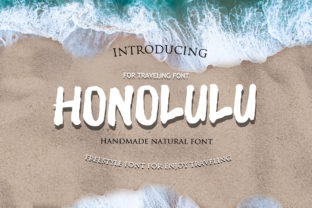
Honolulu: A Light, Charming Sans Serif with Comic Flair
Honolulu is a light and charming sans serif typeface designed with subtle comic sensibility—playful curves, open letterforms, and gentle irregularities that evoke hand-drawn warmth without sacrificing legibility. It’s not a display font meant for fleeting visual impact, nor is it a neutral workhorse like Helvetica or Inter. Instead, Honolulu occupies a thoughtful middle ground: expressive enough to convey personality, restrained enough to support extended reading at modest sizes.
Developed with digital interfaces and print publications in mind, Honolulu balances aesthetic character with functional clarity. Its lowercase ‘a’, ‘g’, and ‘y’ feature soft, rounded terminals; its x-height is generous but not overwhelming; and its stroke contrast is minimal—just enough to add rhythm without introducing visual noise. These traits make it especially well-suited for contexts where tone matters as much as readability: editorial features, brand storytelling, creative portfolios, and user-facing microcopy that aims to feel approachable rather than clinical.
Why Consider Honolulu?
Designers and content creators often seek typefaces that reinforce voice and intention—not just convey text. Honolulu appeals to those who want to signal friendliness, curiosity, or lighthearted sincerity without resorting to overtly decorative or juvenile styles. Its charm lies in restraint: it avoids exaggerated quirks (like bouncing baselines or inconsistent stroke weights) that can undermine professionalism or accessibility.
It’s also a practical choice for projects prioritizing typographic harmony across devices. Honolulu renders consistently on screen thanks to its clean vector outlines and carefully tuned hinting. Unlike some highly stylized script or display fonts, it doesn’t require fallbacks or complex variable font configurations to remain legible on mobile or low-resolution displays.
Benefits and Real-World Strengths
Distinctive yet legible: Honolulu stands out in a landscape of generic sans serifs while maintaining strong character recognition—even at 14–16px body text sizes. Its open counters and generous spacing reduce crowding in longer paragraphs.
Emotionally resonant: The font conveys warmth and approachability, making it effective for brands or publications targeting younger adults, educators, independent creators, or mission-driven organizations seeking to soften formal messaging.
Well-supported and adaptable: Most versions include standard Latin characters, basic diacritics, numerals, and punctuation. Some releases offer stylistic alternates (e.g., a more relaxed ampersand or single-story ‘a’) that allow subtle customization without switching families.
Print-friendly clarity: Its even weight distribution and moderate contrast translate well to offset and digital printing—unlike ultra-light fonts that risk fading or filling in during reproduction.
Tradeoffs and Practical Considerations
Honolulu is not optimized for high-density information environments. In data dashboards, technical documentation, or legal disclaimers where neutrality, density, and rapid scanning are paramount, its expressive qualities may distract or slow comprehension. Similarly, its light weight means it performs poorly at very small sizes (<12px) or against low-contrast backgrounds—designers should test contrast ratios carefully, especially for accessibility compliance.
While Honolulu supports common Western European languages, its character set typically excludes extended Cyrillic, Greek, or East Asian scripts. Projects requiring multilingual typesetting—especially those spanning multiple language families—will likely need supplementary fonts or fallback strategies.
Another consideration is licensing. Honolulu is often distributed under commercial licenses that vary by vendor. Some versions permit web use with limited pageviews; others require annual subscriptions for embedded fonts. Always verify usage rights before integrating into production systems, particularly for SaaS platforms or high-traffic sites.
When Honolulu Fits Best
Honolulu shines in contexts where tone and identity are central to the user experience. Think of a boutique publishing house launching a quarterly magazine about urban culture—the font’s lightness complements candid photography, while its comic inflection adds narrative texture without undermining seriousness. Or consider a mental health app aiming to reduce stigma: Honolulu’s gentle forms can help soften clinical terminology and foster emotional safety in onboarding flows and educational tooltips.
It also works well in branding systems that pair a distinctive primary font with a robust, neutral secondary face (e.g., pairing Honolulu for headings and quotes with Roboto or Source Sans for body copy). This strategy leverages Honolulu’s expressiveness where it has maximum impact—headlines, callouts, logos—while preserving clarity where users spend most of their time reading.
When to Explore Alternatives
If your project demands strict adherence to accessibility standards at all sizes—including WCAG AA/AAA compliance for low-vision users—you may need to prioritize fonts with higher default contrast, larger x-heights, and more distinct character shapes (e.g., Inter, Open Sans, or IBM Plex Sans). Honolulu’s light weight and delicate terminals, while appealing, require careful implementation to meet contrast thresholds reliably.
For enterprise applications, government portals, or financial services interfaces—where trust, precision, and regulatory consistency outweigh stylistic flair—more neutral, widely tested sans serifs remain safer choices. Fonts like Segoe UI, Helvetica Neue, or Work Sans offer broader OS-level support, extensive localization, and decades of real-world performance data.
Finally, if your team lacks typography expertise or your workflow relies heavily on automated design systems (e.g., Figma auto-layout with dynamic text scaling), Honolulu’s nuanced spacing and optical adjustments may require manual tuning—adding overhead that simpler, more predictable fonts avoid.
Making an Informed Choice
Evaluating Honolulu isn’t about whether it’s “good” or “bad”—it’s about alignment. Ask yourself: What role does typography play in this project? Is the goal to communicate efficiently, build emotional resonance, or reinforce brand differentiation? If the answer leans toward the latter two—and your audience values approachability over austerity—Honolulu warrants serious testing.
Before committing, prototype with real content: set sample paragraphs at intended sizes, test across devices and lighting conditions, and gather feedback from diverse readers—not just designers. Pay attention to where attention lingers (does the charm enhance or interrupt?) and where fatigue sets in (does lightness strain eyes over time?).
Also consider long-term maintainability. Will future contributors understand how to use Honolulu effectively? Does your CMS or design system support its stylistic variants? Can you document usage guidelines clearly—or will inconsistency dilute its effect?
Honolulu won’t solve every typographic challenge, but it offers a compelling option for teams willing to thoughtfully weigh expression against utility. When used intentionally—not merely because it’s charming—it becomes more than a font. It becomes part of the conversation.