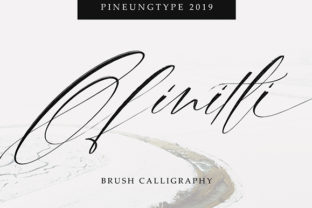
Ofinitti: The Handwritten Font That Feels Human—Not Hand-Drawn
Typography isn’t just about legibility—it’s about voice. It’s the subtle cue that tells your audience whether your brand is playful or polished, urgent or unhurried, personal or professional. And in a digital landscape saturated with clean sans-serifs and overused script fonts, Ofinitti stands apart—not by being “perfect,” but by being unmistakably alive.
What Makes Ofinitti Different From Other Handwritten Fonts?
Most handwritten fonts fall into one of two camps: either they’re meticulously uniform—every loop identical, every baseline mathematically aligned—or they’re so wildly irregular they sacrifice readability for “authenticity.” Ofinitti bridges that gap. It’s not traced from a single pen stroke; it’s built from a curated set of natural variations—subtle shifts in stroke weight, organic entry/exit angles, and intentional inconsistencies that mirror how real handwriting behaves under pressure, speed, and mood.
Unlike many script fonts that rely on OpenType alternates or complex ligature systems to simulate variation, Ofinitti delivers dynamism out of the box. Capital letters have distinct personalities—some begin with a confident upward flick, others with a grounded, almost conversational hook. Lowercase letters flow with rhythmic confidence, yet never feel rehearsed. Even punctuation—commas, periods, ampersands—carries the same hand-guided warmth.
Where Ofinitti Shines (and Where It Doesn’t)
Ofinitti isn’t designed for body text. You won’t want it in a 12-pt paragraph of legal terms or a multi-page product manual. But where it excels is in moments that demand presence and personality:
- Brand logotypes—especially for lifestyle, wellness, creative services, or boutique food brands seeking approachability without sacrificing sophistication;
- Social media visuals, where a single headline in Ofinitti can stop the scroll more effectively than bold sans-serif text;
- Invitations and packaging, where tactile authenticity translates visually—even on screen;
- Animated intros or micro-interactions, where its inherent rhythm pairs beautifully with staggered letter reveals or gentle bounce effects.
It’s worth noting: Ofinitti works best when given breathing room. Pair it with a neutral, highly legible companion font—like Inter, Lora, or even a restrained geometric sans like Manrope—for contrast and balance. Overloading a layout with too much Ofinitti dilutes its impact. One strong headline? Powerful. Three stacked lines of it? Exhausting.
Real-World Use Cases You Can Try Today
Let’s get practical. Here are three scenarios where designers and small business owners report immediate wins with Ofinitti:
- A local ceramic studio launching a new seasonal collection. They used Ofinitti for the campaign headline (“Clay & Quiet”) across Instagram posts, email headers, and limited-edition product tags. The font echoed the handmade nature of their work—but didn’t look like a child’s school project. Customers commented on how “warm” and “intentional” the messaging felt.
- A freelance therapist redesigning her website. Instead of clinical sans-serifs, she chose Ofinitti for section titles (“What to Expect,” “My Approach”). Visitors reported feeling “less intimidated” navigating her site—a subtle but meaningful shift in perceived tone.
- An indie coffee roaster updating their bag design. They swapped a generic brush script for Ofinitti on the origin line (“Single-Origin Guatemalan, Washed”). The result? Shelf presence improved dramatically at local grocers—shoppers described the packaging as “thoughtful,” “artisan,” and “not trying too hard.”
Technical Considerations: What You Should Know Before Licensing
Ofinitti is available in both desktop and web font formats, with standard licensing options covering personal, commercial, and extended use (including app embedding and SaaS platforms). It supports Latin-based languages with full diacritic coverage—so accents in French, Spanish, Portuguese, and German render cleanly.
One thing users consistently appreciate: Ofinitti loads quickly and renders crisply across devices. Its vector outlines are optimized—not bloated with unnecessary nodes—and hinting is carefully tuned for screen legibility at sizes as small as 24px (though we recommend using it at 32px and up for best effect).
If you’re integrating Ofinitti into a WordPress or Shopify site, most modern theme builders support custom font uploads without code. For developers: it includes WOFF2 and WOFF formats, and the CSS @font-face declaration is straightforward. Just be sure to define fallbacks—browsers that don’t load the font should gracefully step down to your secondary typeface, not default to Times New Roman.
Why Designers Are Choosing Ofinitti Over “Trendier” Alternatives
Scroll through Dribbble or Behance, and you’ll see plenty of fonts chasing the “hand-drawn” trend—some with exaggerated flourishes, others with distressed textures or ink bleed effects. Those have their place. But Ofinitti doesn’t rely on gimmicks. Its strength lies in restraint and intentionality.
Consider this: many popular handwritten fonts age poorly. Their quirks become dated fast—think overly bubbly letters from 2015 or forced calligraphic drama from 2018. Ofinitti avoids that trap because it doesn’t mimic a specific era or tool. It mimics human behavior: variation within consistency, confidence without rigidity, warmth without cloying sweetness.
That makes it unusually versatile across industries. A sustainable fashion label uses it for campaign slogans. A financial advisor uses it sparingly in client onboarding emails to soften complex topics. A university art department uses it on exhibition posters—not to shout “creative!” but to signal thoughtful curation.
How to Test If Ofinitti Fits Your Project
Before committing, ask yourself three questions:
- Does this message benefit from a human signature—or would neutrality serve it better? (A law firm’s privacy policy? Probably not. Their “Meet the Team” banner? Absolutely.)
- Is there enough visual contrast between Ofinitti and the rest of your typography system? If everything else is also soft, light, or decorative, Ofinitti will disappear—not stand out.
- Are you prepared to use it selectively? Its power comes from scarcity. Using it once per page—or once per campaign—builds recognition and resonance. Using it everywhere erodes its uniqueness.
Many designers start with a free trial or specimen PDF to test spacing, kerning, and character flow in their actual copy—not lorem ipsum. Try setting your real headline, your real tagline, your real CTA. Does it feel like *you*—or like a version of you that’s been filtered through someone else’s idea of “handmade”?
Final Thought: Typography as Tone, Not Decoration
In the end, choosing Ofinitti isn’t about picking a font—it’s about choosing a tone. It signals care, craft, and quiet confidence. It says, “This wasn’t generated. It was considered.” And in a world where AI tools churn out flawless-but-forgettable visuals by the second, that distinction matters more than ever.
Whether you're building a brand from scratch or refreshing an existing identity, Ofinitti offers something rare: a handwritten font that feels earned, not applied. It doesn’t shout. It leans in. And when used with purpose, it doesn’t just sit on the page—it stays in the mind.