My Autumn: A Handwritten Font That Feels Like a Thoughtful Note from a Friend
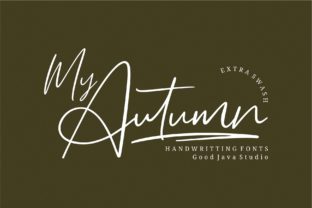
There’s something quietly magnetic about My Autumn—not flashy, not loud, but unmistakably present. It’s a beautiful and light handwritten font with a smart feel: relaxed enough for a personal journal entry, intentional enough for a boutique brand’s packaging, and warm enough to make digital text feel human again. If you’ve ever scrolled past a website or social post and paused—not because of the image, but because the words *felt* like they were written just for you—that’s the kind of quiet resonance My Autumn brings.
Where You’ll Actually Reach for My Autumn (Not Just Download It)
Fonts live or die by real use—and My Autumn thrives where authenticity matters more than perfection. Think of it as your go-to when you want clarity without coldness, personality without clutter.
A freelance educator designing a printable mindfulness worksheet? They choose My Autumn for its gentle rhythm—it guides eyes softly down the page, never shouting instructions. A small-batch candle maker labeling soy wax tins? They use it for ingredient lists and scent notes because it whispers “hand-poured,” not “mass-produced.” A blogger writing a reflective piece on seasonal transitions might set their pull quotes in My Autumn to mirror the tone of quiet intention behind the words.
Real Moments, Real Uses
Here’s how My Autumn shows up—not as decoration, but as part of the experience:
- Wedding stationery that breathes: Invitations, RSVP cards, and ceremony programs gain warmth without sacrificing elegance. Unlike overly ornate scripts, My Autumn keeps readability high—even at 14pt on a linen cardstock—and avoids looking like it belongs in a Victorian library.
- Educational handouts for adult learners: Teachers and workshop facilitators report better engagement when key takeaways or reflection prompts are set in My Autumn. Its open letterforms reduce visual fatigue during longer reading sessions, especially on screens or printed PDFs shared via email.
- Small business email signatures and social bios: A local florist signs off emails with “Warmly, Maya — My Autumn” and instantly signals care over automation. On Instagram, a short bio line in My Autumn stands out in a feed full of bold sans-serifs—without needing extra graphics or filters.
- Digital planners and Notion templates: Creators selling downloadable productivity tools use My Autumn for headers, habit trackers, and weekly reflections. Its light weight prevents interface clutter, while its handwritten quality reinforces the idea of personal growth—not corporate KPIs.
Why It Works Where Other Handwritten Fonts Don’t
Many handwritten fonts fall into one of two traps: either they’re too stiff (like someone trying *too hard* to look casual), or too erratic (hard to read at a glance). My Autumn walks the line with intention. Its baseline is steady, its spacing generous, and its contrast subtle—not dramatic enough to distract, but distinct enough to signal voice.
That “smart feel” isn’t accidental. The lowercase a, g, and y have just enough character to avoid monotony, but no unnecessary flourishes. Capital letters sit comfortably beside lowercase without dominating—making it ideal for titles that need presence, not pomp. And because it’s designed with modern screen rendering in mind, it holds up cleanly even at smaller sizes on mobile devices.
What to Consider Before You Use It
Like any tool, My Autumn shines brightest when matched to the right task—and the right context. Here’s what thoughtful users keep in mind:
- Legibility first: It’s light by design, so avoid using it for body text under 16pt in print or 18px online—especially in low-contrast settings (e.g., light gray on white). Reserve it for headings, quotes, labels, or short-form emphasis.
- Pairing matters: It pairs beautifully with clean, neutral sans-serifs like Inter, Lato, or Open Sans. Avoid pairing it with other decorative or script fonts—that dilutes its quiet confidence.
- Licensing is practical, not punitive: Most versions include both personal and commercial licenses. If you’re using it in client work (e.g., designing a logo or social campaign), double-check the license terms—but don’t assume restrictions where none exist. Many creators find the standard license covers exactly what they need.
- It’s not for every brand: A fintech startup announcing quarterly earnings probably shouldn’t lead with My Autumn. But that same company could use it tastefully in an internal newsletter celebrating team milestones—softening formality without losing credibility.
Who Benefits—and How It Shows Up in Their Work
A yoga studio owner uses My Autumn on class descriptions to evoke calm before students even step onto the mat. A food blogger sets recipe titles in it—not ingredients—to invite curiosity, not just scanability. A therapist designing a client welcome packet chooses it for affirmations and grounding prompts because it feels like a quiet invitation, not a directive.
Even everyday users notice the difference: a parent handwriting a note inside a lunchbox might mimic My Autumn’s flow unconsciously. A student annotating a textbook highlights a key insight and types it in My Autumn later—not for flair, but because it matches the feeling of that “aha” moment.
That’s the quiet power here: My Autumn doesn’t ask to be seen. It asks to be *felt*—as warmth, as clarity, as intention made visible. It’s not about making things look “pretty.” It’s about making them feel true.
One Last Thought Before You Open Your Design App
You don’t need a big project to start with My Autumn. Try it on something small and meaningful: a thank-you note to a colleague, a header for your personal goal tracker, the title of your next blog draft. See how it changes the tone—not just of the text, but of the attention you give it. Because good typography isn’t about rules. It’s about resonance. And My Autumn resonates in the spaces between words—where meaning lives.