Amelya: The Handwritten Font That Feels Like a Thoughtfully Written Note
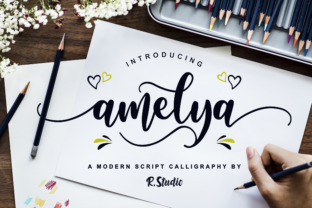
If you’ve ever paused mid-scroll because a website header looked like it was penned by a friend—not a designer—you’ve felt the quiet power of a font like Amelya. It’s not flashy. It doesn’t shout. Instead, Amelya is a classic handwritten font with a delicate feel—slight variations in stroke weight, gentle curves, and subtle irregularities that echo real ink on paper. It’s the kind of typeface that invites trust, warmth, and attention—not because it’s loud, but because it feels human.
Where Amelya Fits Naturally (and Where It Doesn’t)
Amelya isn’t built for dense legal disclaimers or data-heavy dashboards. Its strength lies in moments where tone matters as much as text. Think of it as the visual equivalent of making eye contact before speaking: brief, intentional, and quietly memorable.
Small business owners use Amelya for boutique packaging labels—like a local candle maker printing “Lavender & Rain” on a kraft box. The font doesn’t compete with the product; it complements it. Educators drop it into handouts for creative writing prompts or classroom welcome signs—it softens the institutional feel without sacrificing clarity. Bloggers feature it in email subject lines (“Your weekly dose of calm ✨”) to stand out in crowded inboxes, not with gimmicks, but with sincerity.
Real Situations, Real Decisions
Consider Maya, who runs a wellness coaching practice. She redesigned her client onboarding PDF last month—and swapped her old serif font for Amelya in section headers and affirmations (“You’re allowed to rest”). Clients told her the document “felt like a conversation, not paperwork.” That’s Amelya doing its work: supporting emotional resonance, not just legibility.
Or take James, a freelance illustrator who uses Amelya in his portfolio site’s “About” section. He doesn’t use it for project titles (too light for scanning), but for short personal statements—“I sketch ideas before I explain them.” That one line, set in Amelya, tells more about his process than three paragraphs in a neutral font ever could.
Even in digital spaces where readability is non-negotiable, Amelya finds purpose. A university writing center uses it sparingly—in the “Tips” sidebar of their online grammar guide. Not for the rules themselves, but for the gentle reminders: “Try reading your draft aloud” or “It’s okay to write messy first.” Here, Amelya acts as a visual cue: this isn’t instruction—it’s encouragement.
What Makes It Work So Well (Without Trying Too Hard)
Amelya’s authenticity comes from restraint. It avoids over-stylized loops or exaggerated flourishes. Its lowercase a and g have familiar, unforced shapes—ones you’d see in a thoughtful journal entry, not a calligraphy demo. That familiarity lowers cognitive load: readers recognize it as “handwritten,” but don’t pause to decode it.
Its delicate feel also means it pairs cleanly with sturdy sans-serifs (think Inter, Lato, or even system fonts like Helvetica Neue). Use Amelya for a headline or pull quote, then switch to something neutral for body text. That contrast creates hierarchy without tension—no competing personalities on the page.
When to Reach for Amelya (and When to Pause)
Reach for Amelya when:
- You’re designing something meant to feel personal—invitations, thank-you cards, gift tags, or a heartfelt newsletter sign-up prompt.
- Your brand voice leans warm, reflective, or artisanal—not corporate, tech-forward, or high-energy.
- You need a visual “pause” in otherwise dense content—a single line of emphasis that draws breath, not attention.
Pause before using Amelya if:
- Your audience includes people with dyslexia or low-vision users—and you haven’t tested readability at smaller sizes. While Amelya holds up well at 24pt+, it’s not optimized for long-form reading below 16pt.
- You’re building a mobile-first interface where loading performance matters. As a variable font? No—Amelya is typically delivered as static OTF/TTF files. If you’re embedding it on a high-traffic site, consider subsetting (only loading the characters you need) or using it selectively (e.g., headings only).
- You’re working under tight brand guidelines that require strict font consistency across platforms. Amelya doesn’t have bold or italic variants—its expressiveness lives in its regular weight. That’s a feature, not a flaw—but it does mean you’ll need fallbacks for emphasis (like color shifts or spacing instead of weight changes).
How Different Users Get Practical Value From One Font
Freelancers use Amelya to differentiate proposals—not with fancy graphics, but with a signature-style closing line: “Looking forward to creating something meaningful together.” It subtly reinforces their personal brand without saying a word about “craft” or “passion.”
Hobbyists print Amelya on iron-on transfers for handmade tote bags or embroidery patterns. Because it’s clean and scalable, it holds detail at 1.5 inches tall—unlike some script fonts that blur or lose character at small sizes.
Educators paste Amelya into Google Slides for exit-ticket prompts (“One thing I’m curious about…”). Students consistently report those slides feeling “less formal,” which increases response rates—especially in middle and high school settings where perceived judgment can shut down participation.
Bloggers and creators embed Amelya in Canva templates for Pinterest quotes—paired with muted backgrounds and ample whitespace. These pins consistently outperform generic serif-based designs in saves and clicks, likely because Amelya’s rhythm mimics how people actually jot down ideas: uneven, tender, and lightly imperfect.
A Few Quiet Truths About Choosing Amelya
It won’t fix weak copy. A poorly written tagline set in Amelya still falls flat. But strong words—“slow mornings,” “real talk,” “made with care”—gain texture and weight when given Amelya’s gentle cadence.
You don’t need design training to use it well. Start small: replace one heading on your homepage. Test it in two versions—one with Amelya, one without—and ask three people which feels more aligned with your intent. You’ll likely hear things like “softer,” “more inviting,” or “like it was made just for me.”
And remember: fonts are tools, not trophies. Amelya isn’t about proving you found a rare gem. It’s about choosing the right tool for the feeling you want to leave behind—long after the words are read.