Maybe Yes: A Bold, Charming Script Font
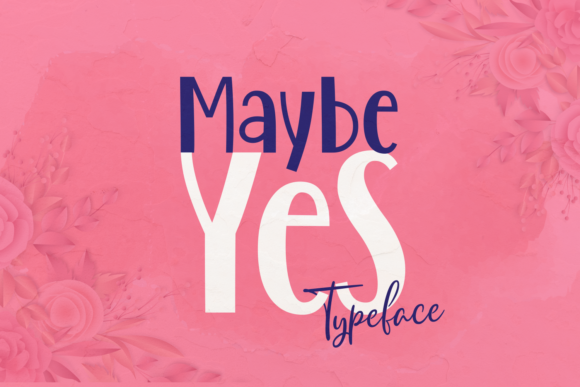
If you’ve ever stared at a design and thought, “It’s almost there—but it needs warmth, confidence, and a little spark,” Maybe Yes is likely the quiet solution you’ve been overlooking. It’s not just another script font. It’s a premium font with intention: generous letterforms, confident contrast, and a rhythm that feels both handwritten and deliberately designed. The uppercase ‘M’ has a decisive downstroke; the lowercase ‘y’ curls with playful authority. There’s no shaky hesitation here—just clarity wrapped in charm.
More Than Just Pretty Letters
Maybe Yes sits comfortably in the script font category, but it avoids the fragility of delicate handwritten fonts and the overused quirkiness of many modern calligraphy styles. Its bold weight gives it presence without sacrificing elegance. It’s not a serif font or a sans serif font—it’s its own kind of expressive display font, built for moments where personality matters most: a boutique’s storefront sign, a wedding invitation suite, the hero text on a small business landing page.
What makes it work so well across contexts is how it balances contrast and consistency. Thick strokes anchor each character, while subtle tapering and open counters keep things legible—even at smaller sizes than most script fonts tolerate. That means it holds up on social media graphics viewed on mobile screens, on product packaging under shelf lighting, and in editorial design where visual hierarchy must guide the eye without shouting.
Where Maybe Yes Earns Its Place
You’ll find Maybe Yes thriving where authenticity meets polish. Think: a local ceramicist’s logo that feels handmade but never amateurish. A wellness brand’s Instagram quote graphic that conveys care—not cutesiness. A cookbook cover where the title breathes alongside food photography, not competes with it. It’s equally at home in digital and print environments because its spacing and proportions were tested across mediums—not just optimized for one.
In branding, Maybe Yes often becomes the emotional signature—the part of a brand identity that says, “We’re thoughtful, human, and sure of our voice.” Paired with a clean, neutral sans serif font (like a well-proportioned geometric or humanist typeface), it creates instant contrast and clarity: Maybe Yes carries the feeling; the companion font delivers the facts. That pairing works for email headers, podcast show notes, book chapter titles, and even embroidered tags on apparel.
It’s also surprisingly versatile in tone. With its upright stance and controlled flow, Maybe Yes reads as warm but not overly casual—ideal for professionals who want approachability without sacrificing credibility. A financial advisor using it for a workshop title? Yes—if paired with strong typography discipline elsewhere. A children’s illustrator using it for a book series logo? Also yes—especially when balanced with friendly, rounded supporting type.
Practical Tips Before You Commit
Before dropping Maybe Yes into your next project, ask yourself three things:
- Is this a moment that needs emphasis, not explanation? Script fonts like Maybe Yes shine as display fonts—not body text. Use it for headlines, logos, pull quotes, or short calls to action. Never for paragraphs or dense interface labels.
- Does your project have room for intentional contrast? If your entire layout relies on decorative type, Maybe Yes will compete instead of complement. Its strength lies in standing out *because* it’s surrounded by restraint.
- Have you checked the included styles? Most quality script fonts come with at least regular and bold weights—and sometimes alternate characters or ligatures. Maybe Yes includes stylistic alternates that soften or sharpen certain letters, letting you fine-tune tone without switching fonts.
Test readability early. Set your key phrase in Maybe Yes at the size it will actually appear—then step back. Does it read instantly, or does the eye pause trying to decode shapes? Script fonts live or die by their clarity in context. If your audience is scanning quickly (on a busy website or crowded tradeshow booth), prioritize legibility over flourish.
Licensing and Real-World Use
Maybe Yes is a commercial font, meaning it requires a license for any use tied to business, promotion, or distribution—even if you’re a solo blogger monetizing via affiliates or a crafter selling handmade goods online. Most reputable vendors offer clear licensing tiers: desktop-only, web font, app embedding, or extended licenses for large-scale publishing or merchandise. Read the terms. Not every “free download” site offers legal usage rights—and using an unlicensed font risks takedowns or legal notice, especially if your brand gains visibility.
For designers handing off assets to clients, include font licensing details in your project documentation. For entrepreneurs building their own brand, treat the font license like any other essential design asset—budget for it, track renewal dates if needed, and store license files securely. It’s not overhead; it’s insurance for consistency and professionalism.
A Font That Grows With Your Work
What sets Maybe Yes apart isn’t just how it looks on day one—it’s how it adapts as your brand evolves. Because it’s bold enough to scale up for signage yet refined enough to sit beside fine illustration or minimalist photography, it doesn’t date quickly. It avoids trends by leaning into time-tested principles: balance, proportion, and expressive control.
You’ll notice it working hardest when it’s not trying too hard—when a café uses it for their chalkboard menu header (paired with a sturdy mono-spaced sans), or when a publisher selects it for the subtitle of a memoir about resilience and quiet joy. In those moments, Maybe Yes doesn’t shout. It affirms. It invites. It says, “Yes—this matters,” without needing exclamation points or extra decoration.
So if your current design feels technically sound but emotionally muted—or if your brand voice is strong but your visuals haven’t quite caught up—Maybe Yes might be the subtle, confident shift you need. Not a fix-all. Not a trend. Just a well-made, human-centered tool, ready to help your message land with warmth and weight.