Manhattan Script: A Distinctive Hand-Drawn Font with Bold, Organic Swashes
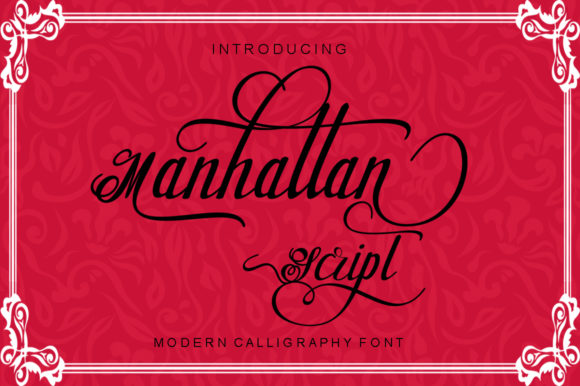
Manhattan Script stands out in the landscape of script typefaces—not by chasing maximal legibility or digital precision, but by embracing expressive imperfection. It’s a hand-drawn script font designed with visible pressure variation, uneven baseline rhythm, and generous, confident swashes that feel both intentional and unrehearsed. Unlike many modern scripts built for speed or scalability, Manhattan Script prioritizes character over consistency—making it especially effective where personality, warmth, and visual distinction matter more than uniformity.
What Makes Manhattan Script Different?
At its core, Manhattan Script is built around organic movement. Its letterforms avoid rigid symmetry: ascenders tilt slightly, descenders curve with subtle asymmetry, and connections between letters follow natural hand-motion logic—not algorithmic interpolation. The bold swashes are not decorative afterthoughts; they’re structural elements that guide the eye and reinforce flow. These swashes appear on capitals, lowercase exits, and select punctuation, lending motion without sacrificing readability at larger sizes.
The font includes multiple stylistic sets—some emphasizing dramatic flourishes, others offering cleaner joins for tighter spacing. OpenType features like contextual alternates and discretionary ligatures allow designers to fine-tune rhythm and avoid repetitive patterns. This level of nuance means Manhattan Script behaves more like a skilled calligrapher than a static typeface: it adapts, responds, and adds texture based on context.
Fitting Into the Broader Script Landscape
Script fonts fall along a spectrum—from tightly controlled formal scripts (often inspired by copperplate or Spencerian penmanship) to loose, brush-based styles meant for immediacy and energy. Manhattan Script sits toward the latter end, but with more discipline than purely casual brush fonts. It’s less structured than fonts like Adorn Display or Lavanderia, yet more deliberate and refined than spontaneous dry-brush or marker-style options.
Compared to widely used alternatives like Great Vibes or Dancing Script, Manhattan Script offers greater visual weight and contrast in its strokes, which translates to stronger presence at display sizes. It also avoids the “default” familiarity of those fonts—meaning it’s less likely to blend into generic wedding invites, café menus, or boutique packaging where distinctiveness is a priority.
Where Manhattan Script Excels—and Where It Doesn’t
Manhattan Script shines in applications where tone and identity carry equal or greater weight than functional neutrality. Think luxury skincare branding, artisanal food labels, editorial feature headers, limited-run book covers, or custom stationery. Its strength lies in evoking craftsmanship, authenticity, and human touch—qualities increasingly valued in an era of algorithmic design.
That said, it’s not built for long-form reading. Body text use is impractical: low x-height, tight counters, and frequent swash overlaps reduce clarity below 24pt. It’s also less adaptable to strict grid systems or highly modular layouts—its charm emerges most fully when given breathing room and thoughtful pairing.
Another practical consideration: Manhattan Script performs best with careful color and background choices. Light swashes can disappear against busy textures or low-contrast backgrounds. When used digitally, hinting and rendering vary across browsers and operating systems—so testing at intended sizes and contexts remains essential.
Realistic Pairing Examples
- For print packaging: Pair Manhattan Script headlines with a crisp, neutral sans-serif like Inter or Public Sans for ingredient lists and legal text. The contrast reinforces hierarchy while keeping the brand voice warm and grounded.
- In editorial design: Use Manhattan Script for pull quotes or section openers alongside a well-spaced serif like Charter or Literata. Its irregularity adds visual punctuation without competing tonally.
- For digital banners: Limit Manhattan Script to single-line headlines no longer than six words. Avoid justified alignment—opt for left-aligned text with manual kerning adjustments where needed to balance visual weight.
Comparing Practical Tradeoffs
Choosing Manhattan Script involves weighing expressiveness against flexibility. Its strengths—distinctive voice, strong visual identity, high perceived craft—are also its constraints. You gain memorability but sacrifice scalability. You gain emotional resonance but need to invest more time in layout refinement.
Consider this comparison: If your goal is fast iteration across dozens of social posts, Manhattan Script may slow you down—not because it’s technically difficult, but because each line benefits from individual attention. A more neutral script with automated ligature support might move faster in those scenarios—even if it feels less special.
Conversely, if you’re designing a one-off brand launch, a gallery catalog, or a bespoke invitation suite, that extra attention becomes an asset. Manhattan Script rewards intentionality. It doesn’t automate personality—it invites collaboration between designer and type.
When to Choose Manhattan Script—and When to Look Elsewhere
Manhattan Script is the right choice when your project values uniqueness over universality, and when your audience responds to tactile, human-scaled aesthetics. It works well for audiences who appreciate detail—readers of independent magazines, patrons of local studios, or customers seeking products with narrative depth.
It’s less suited for environments demanding rapid content turnover, strict accessibility compliance at small sizes, or multilingual support beyond basic Latin characters. While it includes extended Latin glyphs, it lacks robust Cyrillic, Greek, or extended diacritic coverage—so global campaigns or academic publishing may require supplementation or substitution.
If your work regularly crosses platforms—email, mobile app UI, printed collateral—and demands consistent rendering across all, a hybrid approach often serves better: using Manhattan Script for hero elements and a versatile, WCAG-compliant sans-serif for functional text. This preserves impact without compromising usability.
Making a Grounded Decision
Evaluating Manhattan Script isn’t about whether it’s “good”—it’s about whether it aligns with your specific goals, constraints, and audience expectations. Ask yourself:
- Is visual distinction a strategic priority—or is clarity, speed, or broad compatibility more critical?
- Do you have the time and expertise to refine spacing, kerning, and swash placement—or do you need something that works “out of the box”?
- Will this typeface be seen mostly at large sizes (logos, posters, headers), or will it need to function at smaller scales (captions, footnotes, interface labels)?
- Does your brand voice lean toward warmth and craft—or neutrality and efficiency?
There’s no universal “best” script font—only the one that fits your context. Manhattan Script earns its place when that context calls for confidence, character, and a touch of unpolished elegance. It won’t solve every typographic challenge, but where it lands, it lands with presence.
Before committing, test it in your actual workflow: paste real copy, try it against your palette, export at intended resolutions, and view it on the devices your audience uses. Type decisions become clearer not through theory alone—but through applied observation.