Alauna: A Handwritten Font That Earns Its Space
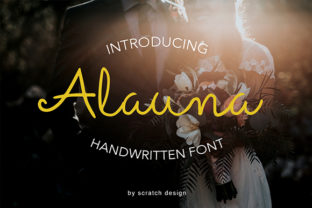
Alauna isn’t just another handwritten font. It’s a deliberately light, authentically imperfect typeface—designed not to mimic handwriting, but to evoke its warmth, intention, and human rhythm. Its subtle irregularities, gentle contrast, and airy letterforms give it presence without weight. That distinction matters. In a landscape saturated with overly polished, algorithmically smoothed scripts, Alauna stands out by refusing to over-perform. It earns attention because it feels considered—not decorative, but communicative.
Why Lightness Matters Strategically
Light fonts are often misread as “weak” or “insubstantial.” But in design strategy, lightness can signal clarity, precision, and restraint. Alauna’s weight sits at the threshold of visibility—legible at scale, expressive at intimacy. That makes it unusually versatile across touchpoints where tone and trust intersect: a founder’s personal email signature, a teacher’s handout header, a boutique brand’s product label, or a nonprofit’s donor thank-you note. It doesn’t shout. It invites closer reading—and that’s where real engagement begins.
When you choose Alauna, you’re not selecting a stylistic flourish. You’re choosing a tonal alignment. Its authenticity isn’t nostalgic—it’s functional. It signals approachability without sacrificing professionalism, creativity without compromising credibility. That balance is rare, especially among handwritten fonts that tend toward either cartoonish playfulness or rigid formality.
Where Alauna Creates Real Leverage
Strategic value emerges when typography supports intent—not just aesthetics. Here’s where Alauna delivers measurable advantage:
- Brand Positioning: For small businesses and solopreneurs building recognition on limited budgets, Alauna helps differentiate without heavy visual investment. A light, hand-drawn logo lockup or wordmark communicates craft and care—especially effective for service-based offerings (coaching, consulting, therapy, education) where human connection is core.
- Customer Experience: In digital interfaces, Alauna works exceptionally well for microcopy that benefits from warmth—onboarding hints, confirmation messages, or personalized dashboard greetings. Its lightness avoids visual fatigue; its authenticity reduces perceived friction.
- Learning & Communication: Educators and course creators report stronger retention when Alauna anchors key concepts in slide decks or worksheets. Its organic rhythm mirrors how people process ideas—not in rigid blocks, but in connected, flowing thoughts. It subtly cues the brain to engage differently than with sterile sans-serifs.
- Creative Workflow: Designers and writers use Alauna early in ideation—sketching headlines, annotating wireframes, or drafting copy. Its low visual dominance keeps focus on structure and meaning, not ornamentation. It’s a tool for thinking, not just presenting.
Using Alauna With Intention—Not Impulse
Like any expressive tool, Alauna amplifies what’s already there. It won’t fix weak messaging, inconsistent branding, or unclear goals. In fact, using it without strategic grounding can backfire: a mismatched tone (e.g., Alauna in a compliance document), overuse (diluting its impact), or poor pairing (clashing with dominant typefaces) erodes credibility faster than a generic font ever could.
Before applying Alauna, ask three questions:
- What emotion or impression must this communicate? If the answer is “authority,” “urgency,” or “technical precision,” Alauna is likely misaligned. But if it’s “thoughtful,” “human-centered,” or “carefully crafted,” it’s a strong candidate.
- At what distance and duration will someone encounter it? Alauna shines at medium-to-close range: printed materials under 12” x 12”, web banners under 768px wide, mobile app UI elements. Avoid it for highway signage, stadium banners, or dense legal footers.
- What’s the hierarchy—and does Alauna serve it? Use Alauna for primary emphasis only when secondary elements (body text, captions, data labels) are grounded in highly legible, neutral typefaces. Its lightness demands contrast to function. Without it, everything recedes.
Practical Pairings and Production Considerations
Alauna performs best when anchored. Pair it with a robust, open-sans or low-contrast serif—something like Inter, Lora, or IBM Plex Sans. Avoid other handwritten or script fonts nearby; contrast in texture, not similarity, creates harmony. For print, test at actual size: its lightness means ink spread or paper absorbency can mute detail. On screen, ensure sufficient line-height (1.5–1.7) and letter-spacing (+20–40 units) to preserve legibility—especially in longer passages.
Also consider licensing context. Alauna is optimized for display use—not body text at small sizes. If your project requires extensive paragraph setting in a handwritten voice, reconsider the goal: readability trumps aesthetic consistency every time. There’s no rule saying all text must “match.” Often, the strongest communication happens when typefaces collaborate, not compete.
Risks of Context-Free Use
The biggest risk with Alauna isn’t technical—it’s conceptual. Using it because it’s “trendy” or “cute” ignores its inherent constraints. A restaurant menu set entirely in Alauna may feel charming at first glance—but frustrate diners scanning prices or dietary notes. A SaaS dashboard using Alauna for all navigation labels sacrifices speed and certainty. These aren’t failures of the font—they’re failures of alignment between tool and outcome.
Similarly, applying Alauna across too many brand assets dilutes its distinctiveness. When everything feels handmade, nothing feels intentional. Reserve it for moments where humanity matters most: the first sentence of a welcome email, the headline above a customer story, the signature line on a proposal. Let it breathe. Let it mean something specific.
Long-Term Value Beyond Aesthetics
Fonts accrue meaning over time—not through novelty, but through consistent, purposeful application. Brands that use Alauna thoughtfully (e.g., a sustainable skincare line using it only on ingredient stories and handwritten batch notes) begin to own its associations: transparency, care, quiet confidence. That kind of earned resonance compounds. It becomes part of the brand’s grammar—not decoration, but vocabulary.
For freelancers and educators, Alauna also functions as a subtle differentiator in crowded markets. When two designers submit similar proposals, the one whose cover note uses Alauna—paired with clean, structured body text—communicates both creativity and discipline. That duality is hard to fake. It reflects a practitioner who understands tools, constraints, and audience needs in equal measure.
Getting Started Without Overcommitting
You don’t need to redesign everything to test Alauna’s fit. Start small:
- Add it to one recurring communication—like your weekly team update subject line or client feedback summary header.
- Use it exclusively for handwritten-style illustrations in presentations—then assess whether audiences respond more warmly or recall content more clearly.
- Apply it to a single landing page section (e.g., testimonials or a founder’s note) and run an A/B test measuring scroll depth or time-on-page—not just clicks.
Measure what matters to your goals—not just “does it look nice,” but “does it support the action I want?” That’s how Alauna transitions from visual choice to strategic asset.
Final Thought: Typography as Decision-Making
Choosing Alauna isn’t about picking a font. It’s about deciding how you want to show up—consistently, clearly, and humanly. It rewards patience, precision, and purpose. Used well, it becomes invisible in the best way: you don’t notice the type—you feel the message. And that’s the mark of truly effective design: not drawing attention to itself, but clearing space for what matters most.