Molliquam: A Handwritten Font with Personality
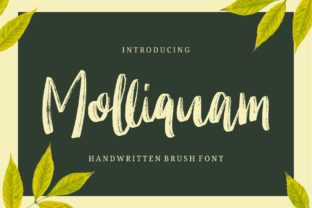
Molliquam isn’t just another script font—it’s a carefully crafted handwritten typeface that feels like it was drawn by a thoughtful hand, not generated by an algorithm. Its subtle inconsistencies—slight variations in stroke weight, gentle tapering on terminals, and organic spacing—give it authenticity and warmth. Unlike overly ornate or rigid scripts, Molliquam balances charm with clarity. It reads easily at medium sizes, holds up well in both digital and print contexts, and carries enough character to stand out without overwhelming your message.
What makes Molliquam especially useful is its versatility within the handwritten category. It avoids the “cutesy” trap that limits many script fonts to birthday cards or baby announcements. Instead, Molliquam supports tone and intention: friendly but professional, personal but polished, relaxed but intentional. That balance is why designers, educators, and small business owners consistently reach for it when they need typography that feels human—not generic.
Where Molliquam Fits Naturally
Molliquam shines where personality matters most—and where over-designing would backfire. Think of it as your go-to for moments that benefit from a quiet confidence rather than loud decoration.
- Small business branding: A local bakery, ceramic studio, or independent therapist might use Molliquam for their logo or website headline—paired with a clean sans-serif for body text—to signal approachability and care without sacrificing professionalism.
- Educational materials: Teachers creating printable worksheets, lesson headers, or classroom posters often choose Molliquam to soften academic content and make learning feel more inviting—especially for younger learners or neurodiverse audiences who respond well to warm, low-pressure visuals.
- Digital content: Bloggers and newsletter writers use Molliquam for email subject lines, section dividers, or pull quotes. Its legibility on screens (especially at 24–36px) means readers pause—not squint—when they see it.
- Printed goods: From wedding invitations to handmade product labels, Molliquam adds tactile warmth. When printed on textured paper or letterpress, its natural rhythm enhances perceived craftsmanship.
Designing With Intention—Not Just Decoration
Using Molliquam well isn’t about applying it everywhere—it’s about choosing moments where handwriting adds meaning. Ask yourself: Does this element benefit from feeling personal? Does it guide attention, soften tone, or reinforce voice? If the answer is yes, Molliquam likely fits.
For example, a freelance illustrator launching a new workshop series might use Molliquam only for the workshop title (“Sketching With Confidence”) while keeping dates, locations, and pricing in a neutral, highly readable sans-serif. That contrast creates hierarchy—and gives the title emotional resonance without sacrificing usability.
Similarly, a wellness coach building a client workbook could set chapter openers in Molliquam to evoke reflection and presence, then switch to a clean, accessible typeface for exercises and prompts. The shift in texture signals a change in mode: from invitation to action.
Avoiding Common Pitfalls
Even expressive fonts need boundaries. Molliquam works best when it has room to breathe and contrast. Here’s what to keep in mind:
- Don’t set full paragraphs in Molliquam. Its beauty lies in emphasis—not endurance. Use it for headings, short quotes, callouts, or logos.
- Pair it thoughtfully. A crisp, geometric sans-serif (like Inter, Poppins, or Montserrat) or a warm, humanist serif (like Lora or Merriweather) provides ideal balance. Avoid pairing it with other scripts or overly decorative fonts—they compete instead of complement.
- Respect line length and spacing. At smaller sizes or tight tracking, Molliquam’s delicate joins can blur. Stick to generous letter-spacing (50–100 units in design tools) and line heights of 1.4–1.6 for display use.
- Test across devices. While Molliquam renders cleanly on modern browsers and apps, preview how it appears on mobile email clients or older tablets—especially if used in newsletters or landing pages.
Ideas You Can Try This Week
You don’t need a big project to explore Molliquam’s potential. Start small—and build from there.
- Redesign one recurring element—like your email signature, social media story highlight icon, or Notion page header—with Molliquam. Notice how even that tiny shift affects tone.
- Create a branded quote graphic using Molliquam for the quote and a simple sans-serif for attribution. Post it where your audience already engages—LinkedIn, Instagram, or a community forum.
- Swap your current logo wordmark (if text-based) with Molliquam for 48 hours. Show it to three trusted people—not to ask “Do you like it?” but “What does this version tell you about the work?” Their answers will reveal whether it aligns with your intended voice.
- Use it to label physical items—a notebook cover, a recipe card, or a gift tag. Seeing Molliquam in real life helps you understand its texture, weight, and warmth in ways screen previews can’t match.
Who Benefits Most—and Why
Molliquam resonates strongest with creators who value clarity *and* connection. That includes:
- Freelancers and solopreneurs who want their brand to reflect their individuality without seeming unpolished;
- Educators and coaches whose work relies on trust and accessibility;
- Bloggers and content creators aiming to differentiate their voice in crowded feeds;
- Small retailers and makers who sell handmade or locally rooted products and want packaging or signage that feels considered, not stock;
- Hobbyists and journalers seeking a font that supports self-expression without demanding technical skill.
It’s less suited for corporate reports, legal disclaimers, or interfaces requiring rapid scanning—but that’s not a limitation. It’s a signal: Molliquam belongs where humanity matters more than speed.
Final Thought: Typography as Tone
Fonts don’t speak—but they set the conditions for speaking. Molliquam invites warmth, suggests sincerity, and quietly communicates that care went into the details. That’s valuable in any context where people are choosing whether to listen, buy, learn, or return.
You don’t need to overhaul your entire system to benefit from it. Start with one place where your audience pauses—even briefly—and give that moment a little more personality. Let Molliquam do what it does best: add charm, not clutter; distinction, not distraction.