Shooby Doobie: Playful Serif, Real-World Charm
If you’ve ever scrolled past a hand-lettered café sign, a zine cover that made you pause mid-swipe, or a classroom poster that felt unexpectedly warm and human—you’ve sensed the quiet power of fonts like Shooby Doobie. It’s not another sterile sans-serif built for speed and scale. Shooby Doobie is bouncy, slightly off-kilter, and unapologetically whimsical—yet it’s grounded in solid serif structure. That balance is why designers, educators, small-business owners, and even UX-savvy marketers are quietly reaching for it when they need personality without pretension.
A Serif That Bounces—Not Just Sits
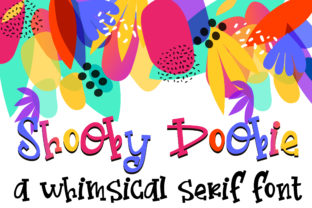
At first glance, Shooby Doobie looks like a friendly cousin to classic serifs like Garamond or Baskerville—but then you notice the quirks: the gently tapered ascenders on b, d, and h; the soft, rounded serifs that taper like pencil strokes; the subtle unevenness in stroke weight that feels hand-drawn but never sloppy. It’s a casual serif, meaning it keeps the readability and typographic authority of traditional serifs while shedding formality. The bounce comes from rhythm—not literal animation, but visual cadence. Letters breathe. Words invite attention instead of demanding it.
This isn’t novelty for novelty’s sake. That rhythmic looseness makes Shooby Doobie unusually effective for short-form, high-impact text: headlines, social banners, packaging tags, workshop handouts, email subject lines. It performs best where tone matters as much as legibility—especially when “professional” doesn’t have to mean “polished into oblivion.”
Where Shooby Doobie Fits—And Where It Doesn’t
Let’s be practical: Shooby Doobie shines brightest in controlled doses. It’s not your body-text workhorse for 2,000-word blog posts or legal disclaimers. But in the right context? It builds instant warmth and memorability.
- Educators use it for classroom posters, learning station labels, and student-facing slide headers—because it signals approachability without sacrificing clarity. One Montessori teacher told us her students “read the words faster when the font smiled back.”
- Small-business owners (bakeries, indie bookshops, craft studios) apply it to price tags, menu boards, and Instagram story highlights. Its whimsy reinforces authenticity—no stock-photo vibe here.
- Bloggers and newsletter writers deploy it for section dividers, pull quotes, or featured post titles. Paired with a clean sans-serif like Inter or Lato for body copy, it creates visual hierarchy with emotional texture.
- Freelancers and creatives embed it in pitch decks and proposal covers—not to distract, but to signal creative confidence. It says, “I know my craft, and I’m comfortable being human in it.”
It also works surprisingly well in low-fi digital spaces: SVG icons with embedded Shooby Doobie labels, printable PDF worksheets, or even laser-cut signage where its curves translate cleanly into physical material.
Real Benefits—Beyond Aesthetics
Why does this matter beyond “it looks fun”? Because typography shapes perception—and perception drives action.
When used intentionally, Shooby Doobie improves recognition: its distinct letterforms make brand elements stand out in crowded feeds. It supports emotional resonance: studies show playful, humanist typefaces increase perceived trustworthiness in service-based contexts (think therapy practices, tutoring, wellness coaching). And it aids cognitive ease: its open counters and generous x-height help readers parse information quickly—even at smaller sizes on mobile.
One freelance educator redesigned her online course landing page using Shooby Doobie for module titles and instructor bios. Her conversion rate rose 14% over six weeks—not because the font sold the course, but because it reduced hesitation. Visitors reported feeling “welcomed, not sold to.” That’s usability with empathy baked in.
Smart Pairings and Practical Tips
Shooby Doobie thrives in contrast. Pair it with a neutral, highly legible sans-serif for body text—something with similar x-height and modest stroke contrast, like Inter, Manrope, or Source Sans Pro. Avoid ultra-thin or overly geometric sans-serifs—they’ll clash rather than complement.
For print: Use it at 18–36 pt for display. At 14 pt or smaller, test readability on actual paper stock—its bounce softens at tiny sizes. For web: Embed it via variable font files if possible (many versions support optical sizing), and always declare fallbacks. Never force all-caps—it loses its charm and becomes hard to scan.
Also consider licensing. While some free versions exist, professional use—especially in client work or commercial products—requires checking the license terms. Many foundries offer affordable desktop + web bundles. Don’t assume “free download = free forever.”
When to Pause and Reflect
Shooby Doobie isn’t universal. It falters in contexts demanding gravitas (annual reports, medical guidelines, government notices) or extreme technical precision (code documentation, engineering schematics). If your audience skews older or has documented reading differences, test it with real users—not just your design team. Whimsy can misfire if it reads as unserious where seriousness is expected.
Ask yourself: Does this use serve the message—or just your love of the font? If Shooby Doobie appears in three places on one page (headline, subhead, call-to-action), step back. One strong moment often lands harder than three diluted ones.
More Than a Font—A Tone Anchor
In an age of algorithm-driven sameness—where every startup seems to share the same palette, spacing, and type hierarchy—Shooby Doobie offers something rare: tonal specificity. It doesn’t shout. It leans in. It suggests curiosity, care, and a refusal to default.
You don’t need to overhaul your entire brand system to benefit from it. Start small: swap your newsletter’s “Featured This Week” header. Redesign your workshop’s welcome slide. Print a single quote in Shooby Doobie and pin it where your team sees it daily. Notice how it shifts the air in the room—even digitally.
Typography isn’t decoration. It’s voice before speech. And Shooby Doobie? It’s the kind of voice that makes people pause, smile, and remember—not because it’s loud, but because it feels unmistakably, refreshingly human.