Josefov: Where Precision Meets Personality in Typography
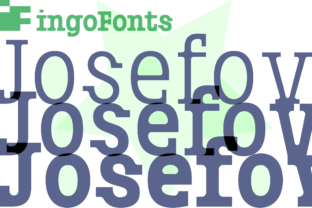
Imagine a typeface that feels like it belongs on both a vintage blueprint and a cutting-edge dashboard—structured, confident, and quietly expressive. That’s Josefov: a narrow slab serif font with a modern twist, designed not just to be read, but to be trusted.
A Typeface Built for Clarity—and Character
At first glance, Josefov stands out for its clean geometry and tightly spaced letterforms. Its narrow proportions make it exceptionally efficient in constrained spaces—think mobile interfaces, data-dense dashboards, or compact product labels—without sacrificing legibility. But what truly sets Josefov apart is its subtle human touch: slight variations in stroke contrast, carefully tuned terminals, and a restrained warmth in its curves. It avoids the cold rigidity of many technical fonts while staying firmly grounded in functional design.
This balance isn’t accidental. Josefov draws inspiration from mid-century engineering typography—think instrument panels, architectural signage, and analog control systems—but reinterprets those cues for today’s digital context. The result? A font that feels both authoritative and approachable, technical yet inviting.
Who Benefits Most from Josefov?
Josefov isn’t a one-size-fits-all solution—but it’s an ideal match for specific needs and audiences. Here’s where it shines:
- Product designers integrating typography into hardware interfaces, IoT displays, or embedded UIs—where space is limited and readability under varied lighting is non-negotiable.
- Brand strategists building identity systems for tech-adjacent companies (e.g., sustainability platforms, fintech tools, or lab-grown material startups) that want to signal competence without sterility.
- Editorial designers crafting tight, high-information layouts—like financial reports, academic abstracts, or exhibition wall texts—where hierarchy must emerge through spacing and weight, not size alone.
- Small business owners selecting a distinctive yet professional logo or stationery font—especially in architecture, engineering, design studios, or artisanal manufacturing—where credibility meets craftsmanship.
Real-World Applications You Can See Today
Consider a climate analytics dashboard: dense grids of real-time metrics, toggles, and status indicators. Using Josefov for labels and values creates immediate visual cohesion—its consistent x-height and open counters ensure numbers and abbreviations (like “kW”, “°C”, or “CO₂”) remain distinct at small sizes.
Or picture a boutique architecture firm’s website. Their project titles appear in bold Josefov, paired with airy sans-serif body text. The contrast signals intentionality—not flashiness, but clarity of purpose. Visitors subconsciously register expertise before reading a single sentence.
Even in print, Josefov holds up. A limited-edition product manual for a modular furniture system uses it for captions and specifications. Its narrow width allows more detail per page; its slab serifs anchor technical terms without overwhelming the layout.
Strengths That Go Beyond Aesthetics
What makes Josefov especially useful isn’t just how it looks—it’s how it performs:
- Space efficiency: Up to 15% narrower than standard slab serifs at equivalent readability—ideal for responsive navigation bars or tight label fields.
- Scalability: Maintains crispness from 10pt print captions to 48pt hero headings, thanks to robust hinting and balanced stroke modulation.
- Distinctive neutrality: It doesn’t shout personality like display fonts, nor fade into background like generic system fonts—it occupies a rare middle ground: memorable but never distracting.
- Technical harmony: Designed with monospaced logic in mind, Josefov aligns beautifully with code snippets, terminal-style UIs, or tabular data—making it a natural companion for developer-facing tools.
Practical Considerations Before You Commit
Like any thoughtful tool, Josefov works best when matched to the right task. Keep these points in mind:
- Not ideal for long-form body text: Its narrow proportions and strong vertical stress can fatigue readers over paragraphs. Reserve it for headings, labels, captions, and short bursts of information.
- Weight range matters: While Josefov offers multiple weights, its true strength lies in the Medium, SemiBold, and Bold variants. The Light version sacrifices some of its structural confidence; the ExtraBold leans toward display use only.
- Pairing strategy: It pairs exceptionally well with humanist sans-serifs (like Inter, Manrope, or Source Sans Pro) or even gentle geometric types (e.g., IBM Plex Sans). Avoid clashing with other slab serifs or overly decorative fonts—the goal is contrast, not competition.
- Licensing clarity: Confirm usage rights early—some versions support web embedding with variable font capabilities; others are optimized for desktop or app use. Always check the license for your deployment environment (e.g., SaaS platforms, mobile apps, or printed collateral).
How to Evaluate If Josefov Fits Your Project
Ask yourself these three questions:
- Is legibility under constraint a priority? If your text appears in tight columns, small screens, or alongside icons and graphs, Josefov’s engineered clarity becomes an asset—not just style.
- Does your brand value substance over flair? If your messaging centers on reliability, innovation, or meticulous process—not whimsy or nostalgia—Josefov reinforces that tone without saying a word.
- Do you need typographic distinction without distraction? If your audience should focus on content, data, or action—not the font itself—Josefov delivers presence without pretense.
If two or more answers are “yes,” Josefov deserves serious consideration.
More Than a Font—A Design Decision
Choosing Josefov isn’t about following a trend. It’s about recognizing that typography shapes perception faster than color or layout. In a world saturated with rounded, friendly, or ultra-thin fonts, Josefov offers something rarer: quiet authority.
It doesn’t try to be everything. It excels where precision matters—on a sensor readout, in a compliance document, beside a hand-drawn schematic, or beneath a minimalist logo. Its narrow slab structure isn’t a limitation; it’s a focused lens.
For creators who believe good design serves first and impresses second, Josefov is less of a stylistic choice—and more of a functional ally.
Getting Started Thoughtfully
Before downloading or licensing Josefov, test it in context:
- Drop it into your actual UI mockup—not just a font specimen page.
- Print a sample at 8pt and 12pt to assess ink spread and contrast on your intended paper stock.
- Run accessibility checks: Does it maintain sufficient contrast against your background colors? Does it scale cleanly in browser zoom modes?
- Compare it side-by-side with your current fallback font. Does it improve scannability? Does it strengthen your message—or just change the surface?
When used intentionally, Josefov does more than fill space. It communicates rigor. It invites attention without demanding it. And in an age where users scroll past content in seconds, that kind of quiet impact is anything but minor.