Huddersfield: A Stylish Handwritten Font for Contemporary Design Projects
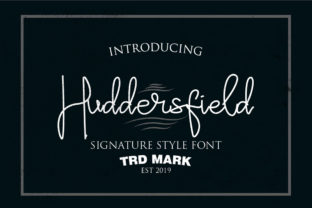
Huddersfield is a distinctive handwritten font designed to bridge elegance and modernity. It’s not merely decorative—it carries intentionality in its letterforms, with confident strokes, subtle contrast, and balanced rhythm that give it both personality and readability. Unlike many script fonts that lean heavily into ornate flourishes or casual informality, Huddersfield occupies a refined middle ground: expressive enough for artistic expression, yet structured enough for professional applications.
What Sets Huddersfield Apart
At first glance, Huddersfield stands out through its bold, assured handwriting style—each character feels hand-drawn but never rushed or uneven. Its uppercase letters feature graceful entry and exit strokes, while lowercase forms maintain consistent x-height and open counters, supporting legibility even at smaller sizes. The font includes standard ligatures and contextual alternates, allowing natural word shapes without manual intervention. Importantly, Huddersfield avoids over-stylisation: no excessive swashes, no forced irregularity, no visual noise that distracts from the message.
This restraint makes Huddersfield especially effective in contexts where tone matters as much as typography—brand identities seeking warmth without sacrificing credibility, editorial layouts wanting personality without compromising clarity, or packaging designs aiming for premium appeal grounded in authenticity.
How It Compares With Other Script Fonts
When evaluating script fonts, designers often weigh three interrelated qualities: expressiveness, functionality, and versatility. Huddersfield scores highly on all three—but not equally across every use case.
Compared to more delicate scripts—those with ultra-thin hairlines and dramatic contrast—Huddersfield offers greater visual weight and presence. It holds up well on backgrounds with texture or subtle gradients, where finer scripts might disappear. In contrast, bolder brush-style fonts often sacrifice nuance for impact; Huddersfield retains subtlety in stroke modulation, giving it a more human, less mechanical feel.
Its spacing and kerning are carefully tuned—not so tight as to create visual clutter, nor so generous as to weaken typographic cohesion. This means it works reliably in both short-form settings (like logos or social media banners) and longer passages (such as invitation copy or boutique website headlines), though it’s not intended for body text.
Strengths in Practice
Huddersfield excels when the goal is to communicate sincerity, craftsmanship, or individuality. For example:
- A small-batch candle brand uses Huddersfield for product names and scent descriptions—its warmth reinforces artisanal positioning without veering into cliché.
- An independent wedding stationery designer pairs Huddersfield with a clean sans-serif for invitations: the contrast highlights hierarchy while keeping the overall aesthetic cohesive and contemporary.
- A lifestyle blogger selects Huddersfield for newsletter headers and featured quote graphics—its boldness ensures visibility in crowded inboxes, while its handwritten nature supports a personal, trusted voice.
In each scenario, Huddersfield contributes tonal consistency rather than visual dominance. It doesn’t shout; it invites attention through confidence and clarity.
Limitations and Realistic Tradeoffs
No script font is universally suitable—and Huddersfield is no exception. Its strengths become limitations in certain environments. Because it’s a single-weight, non-variable design, it lacks built-in options for bolding or italicising within the same family. Users needing typographic hierarchy beyond size or colour must pair it thoughtfully with complementary typefaces.
It also performs best above 24pt in digital interfaces and 14pt in print. Below those thresholds, some details—particularly in tighter letter combinations like “fl” or “st”—can lose definition. This isn’t a flaw, but a functional constraint worth noting during layout planning.
Additionally, while Huddersfield supports Latin-based languages and common diacritics, extended language support (e.g., Cyrillic, Greek, or Vietnamese) is limited. Projects requiring multilingual typesetting may need supplemental fonts or custom solutions.
When Huddersfield Is the Right Choice
Huddersfield fits naturally into projects where authenticity and polish coexist as priorities. It’s particularly well-suited for:
- Branding initiatives for creative studios, wellness practitioners, or boutique retailers—where differentiation hinges on emotional resonance as much as visual distinction.
- Print collateral such as greeting cards, posters, or limited-edition packaging—where tactile quality and intentional design elevate perceived value.
- Digital touchpoints like hero banners, email headers, or Instagram story text overlays—where quick recognition and stylistic coherence matter more than dense textual information.
If your project centres around storytelling, personal connection, or curated aesthetics—and if you’re willing to invest time in thoughtful pairing and sizing—Huddersfield provides a strong foundation.
When Another Option Might Be Better
Huddersfield may not be ideal if your needs include:
- High-density text environments, such as long-form blog posts, product descriptions, or documentation—where readability and scanning efficiency outweigh stylistic flair.
- Strict accessibility requirements, especially for users relying on screen readers or low-vision accommodations. While Huddersfield itself isn’t inaccessible, its decorative nature means it should never serve as primary interface text or alt-text labels.
- Dynamic or responsive systems requiring variable weights, optical sizing, or automated scaling—since Huddersfield is a static, desktop-optimised font file.
- Budget-constrained workflows where licensing complexity or cost per user becomes prohibitive. As a premium font, it requires appropriate licensing for commercial use—unlike freely available alternatives that may offer broader usage rights at the expense of distinctiveness.
In these cases, evaluating alternatives—whether a versatile serif with script-inspired details, a minimalist handwritten option with wider language support, or a system font used with intentional styling—may yield better long-term results.
Making an Informed Decision
Choosing a font like Huddersfield isn’t just about aesthetics—it’s about alignment. Does its tone match your audience’s expectations? Does its technical behaviour support your delivery medium? Will it scale gracefully across devices, sizes, and contexts?
Before committing, test it in real conditions: set actual headlines alongside your chosen body font, preview it on mobile screens, check contrast ratios against background colours, and assess how it renders in PDF exports or email clients. Many designers find that sketching rough mockups with Huddersfield helps clarify whether its energy enhances—or competes with—their content.
Ultimately, Huddersfield serves best when treated as a deliberate design decision—not a decorative afterthought. Its boldness and elegance come from consistency of execution, not just appearance. When paired with care, spaced with intention, and applied where its strengths shine, it transforms ordinary layouts into memorable ones—without demanding attention at the expense of meaning.