Freeflow: The Monoline Script Font That Brings Effortless Elegance to Real-World Design
When you're designing a wedding invitation, launching a boutique skincare brand, or refreshing your portfolio site, the right font does more than convey words—it sets tone, builds trust, and quietly signals intention. Freeflow is a monoline script font designed for exactly that moment: when simplicity and sophistication must coexist without compromise. It’s not ornate or overly decorative—instead, Freeflow delivers clean, rhythmic letterforms with subtle personality, making it ideal for designers and non-designers alike who want elegance that feels intentional, not imposed.
Many professionals face a quiet but persistent challenge: finding a script font that looks refined *without* sacrificing legibility, versatility, or ease of use. Overly flourished scripts can overwhelm small screens or blur in print; rigid sans-serifs lack warmth for personal or artisanal contexts; and many “elegant” fonts demand advanced typographic knowledge to pair well or scale properly. These aren’t just aesthetic hurdles—they slow down projects, increase revision cycles, and dilute brand clarity. If you’ve ever spent 45 minutes toggling between script options only to default to something safe (and forgettable), you’re not alone.
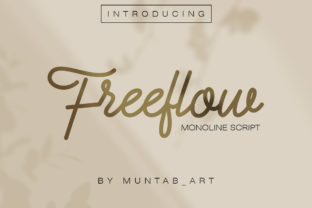
Freeflow solves this by prioritizing function alongside form. As a true monoline script—meaning every stroke carries consistent weight—it avoids visual noise while preserving fluidity and grace. There are no dramatic thick-thin transitions to misrender at small sizes or on low-resolution displays. Its open counters and generous spacing support readability across mediums: from laser-engraved wood signs to mobile-first email headers. And because its rhythm is natural—not mechanical—it pairs intuitively with neutral sans-serifs like Inter, Lato, or even system fonts, requiring no typography degree to get right.
Consider these everyday scenarios where Freeflow makes implementation smoother and outcomes stronger:
- Small business branding: A ceramicist launching an online shop uses Freeflow for her logo and product tags. The font’s gentle curves echo hand-thrown forms, while its consistency ensures cohesion across Instagram bios, packaging labels, and Etsy banners—no need for custom vector adjustments at each size.
- Event design: A freelance planner selects Freeflow for digital save-the-dates and printed menus. Its even stroke weight prevents ink spread on textured paper, and its lowercase ‘g’, ‘y’, and ‘f’ have just enough character to feel bespoke—without looking fussy or dated.
- Personal portfolios: A UX designer adds Freeflow to her website’s hero section headline (“Crafting Human-Centered Experiences”). Paired with a crisp, accessible body font, it introduces warmth and individuality—reinforcing creativity without undermining professionalism.
What makes Freeflow especially valuable is how little it asks of you. Unlike script fonts that require ligature management, manual kerning, or OpenType feature toggling, Freeflow works out of the box. You type, and it flows—literally and figuratively. That means faster mockups, fewer client revisions focused on “font mood,” and more time invested in strategy, storytelling, or user experience.
Of course, context matters. Not every project needs script energy—and Freeflow isn’t meant to replace functional workhorses like Roboto or Georgia. Instead, think of it as a precision tool: most effective when applied deliberately and sparingly. Use it for headlines, logos, short quotes, or accent text—not long paragraphs or data tables. When used thoughtfully, it elevates without distracting; refines without overcomplicating.
Different users approach Freeflow in ways that reflect their goals and constraints:
- Non-designers (entrepreneurs, educators, creators) appreciate how easily it integrates into Canva, Google Slides, or Squarespace. No font installation required in many cases—and its visual confidence helps bridge the gap between “I made this myself” and “This feels professionally crafted.”
- Graphic designers
- Developers integrating web fonts benefit from Freeflow’s lightweight file size and broad browser support. It renders cleanly across Chrome, Safari, Firefox, and Edge—even with variable font fallbacks disabled—making it a low-risk, high-return typographic choice for modern CSS workflows.
For best results, keep these practical considerations in mind:
- Size wisely: Freeflow shines at 24px and above for digital display, and 14pt+ for print. Avoid using it smaller than 16px in UI contexts unless heavily optimized for contrast and spacing.
- Pair with purpose: Let Freeflow lead emotionally, then ground it with a highly legible, neutral sans-serif or slab-serif for body copy. Avoid pairing with other scripts—or decorative serifs—that compete for attention.
- Respect hierarchy: Use Freeflow for one key element per layout—your logo, your headline, your call-to-action. Multiple script layers quickly erode clarity and perceived credibility.
- Test real content: Try it with your actual brand name, tagline, or customer-facing phrase—not just “The quick brown fox.” Letter combinations like “ll”, “ff”, or “tt” should feel balanced, not cramped or loose. Freeflow handles these gracefully, but verification ensures alignment with your voice.
Ultimately, Freeflow stands apart not because it does everything—but because it does one thing exceptionally well: it brings calm, confident elegance to moments that matter. It doesn’t shout. It doesn’t apologize. It simply flows—cleanly, consistently, and with quiet authority. Whether you're refining a client’s brand identity, preparing a presentation for stakeholders, or designing a heartfelt note for a friend, Freeflow offers a rare balance: beauty that serves the message, not overshadows it.
If you've been searching for a script font that feels both timeless and approachable—something that enhances rather than complicates your workflow—you’ll find Freeflow isn’t just another typeface. It’s a thoughtful solution, ready to help you communicate with clarity, warmth, and unmistakable polish.