Amoura: A Light-Handed, Whimsical Font for Delicate Typographic Moments
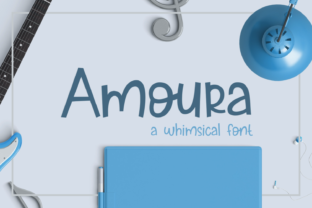
Amoura is a handwritten typeface that balances elegance with approachability. Its defining trait is a light, airy stroke weight—neither bold nor condensed—giving it a soft presence on the page or screen. Unlike many script fonts that lean heavily into formal calligraphy or energetic brushwork, Amoura occupies a quieter space: one of gentle rhythm, subtle variation in letterforms, and intentional openness. It’s not designed to dominate; it’s designed to invite.
What Makes Amoura Distinctive
At first glance, Amoura feels familiar—like handwriting you might see in a thoughtful note or a carefully composed invitation. But closer inspection reveals deliberate craftsmanship: slight irregularities in baseline alignment, organic entry and exit strokes, and a consistent yet unhurried pace across characters. These aren’t flaws; they’re cues that signal human touch without sacrificing legibility.
The font includes standard Latin characters, numerals, and common punctuation, with support for basic diacritics. It does not include extensive language coverage (e.g., Cyrillic, Greek, or extended Vietnamese), nor does it offer stylistic alternates, swashes, or contextual ligatures. That restraint is part of its identity—it prioritizes clarity and cohesion over decorative complexity.
Amoura’s lightness extends beyond visual weight. It scales well at larger sizes (24–60pt) for headings and short quotes, but begins to lose definition below 14pt in body text applications. This isn’t a limitation so much as a design intention: it’s built for moments where typography supports tone rather than conveys dense information.
Where Amoura Fits Among Handwritten Fonts
Handwritten fonts fall along several spectrums: formality vs. informality, density vs. airiness, consistency vs. spontaneity. Amoura sits toward the lighter, more consistent, and gently formal end. It’s less improvisational than fonts inspired by marker or chalk, and less rigid than copperplate-style scripts.
Compared to heavier handwritten options—those with thick downstrokes and dramatic contrast—Amoura reads as calmer and more neutral. It doesn’t carry the urgency of a quick jot or the gravitas of an engraved monogram. Instead, it suggests quiet confidence: think artisanal packaging labels, wedding stationery for outdoor ceremonies, or editorial pull quotes in lifestyle magazines.
It also differs from “bouncy” or highly animated scripts—fonts that use exaggerated ascenders, looping connectors, or exaggerated slant. Amoura’s letters connect with modest, graceful joins. The x-height is generous, and spacing between letters is open, contributing to its breathable feel. That openness makes it more versatile in tight layouts than denser scripts, especially when paired with clean sans-serif companions like Lato, Inter, or Source Sans Pro.
Practical Use Cases Where Amoura Excels
- Wedding and event branding: Invitations, menus, and signage benefit from Amoura’s warmth without veering into cutesy or overly ornate territory.
- Small-batch product labeling: Artisanal soap, loose-leaf tea, or handmade candles often rely on typography that feels personal and unhurried—Amoura delivers that without looking DIY or unpolished.
- Digital editorial accents: In blog posts or newsletters, Amoura works well for short, evocative headlines or highlighted phrases—especially when the surrounding text is set in a highly readable, neutral typeface.
- Branding for wellness, creativity, or slow-living spaces: Its lightness aligns naturally with values like mindfulness, craft, and intentionality—without needing illustration or color to reinforce the message.
When Amoura May Not Be the Best Fit
Amoura’s strengths become limitations in certain contexts. It is not suited for long-form reading—its lack of true italics, limited character variants, and modest x-height reduce readability in paragraphs. Similarly, environments demanding high contrast or accessibility compliance (e.g., government websites, educational platforms, or public signage) may find Amoura too low-contrast or insufficiently distinct at small sizes.
If your project requires multilingual support beyond Western European languages, Amoura won’t accommodate those needs. Nor does it scale effectively for mobile interfaces where fine strokes can blur or disappear on lower-resolution displays. In those cases, a more robust script—or a hybrid solution pairing a simple serif or sans-serif with subtle handwritten accents—may serve better.
Another consideration is tone alignment. Amoura communicates serenity and subtlety—not energy, authority, or technical precision. Using it for a fintech dashboard, legal disclaimer, or tech startup headline could unintentionally undercut credibility. It’s not “wrong,” but it may misalign with audience expectations.
Pairing Amoura Thoughtfully
Successful pairing hinges on contrast without conflict. Because Amoura is light and fluid, it pairs best with typefaces that offer structure, neutrality, and moderate contrast. Avoid other scripts or overly decorative fonts—they compete for attention and muddy hierarchy.
Effective pairings often follow this logic:
- Headline (Amoura) + Body (sans-serif): For example, Amoura at 32pt over Inter Regular at 18pt creates clear visual hierarchy while maintaining harmony in proportion and spacing.
- Short quote (Amoura) + Caption (serif): A pull quote in Amoura with a caption in Merriweather or PT Serif adds quiet sophistication without visual noise.
- Logo lockup (Amoura wordmark) + Supporting type (geometric sans): Combining Amoura with a crisp, modern sans like Montserrat or Poppins grounds the brand in both personality and professionalism.
Avoid pairing Amoura with fonts that share its lightness but lack contrast—such as another delicate script or ultra-thin sans-serif. Without sufficient distinction, the layout risks feeling indistinct or fragile.
Making the Decision: Does Amoura Match Your Needs?
Ask yourself these questions before choosing Amoura:
- Is the primary use for short, expressive text—not extended reading?
- Does your brand or project value softness, authenticity, and understated charm over boldness or efficiency?
- Will the font appear at sizes where its light strokes remain legible and intact?
- Do you have a clear, complementary typeface ready to handle functional text (body copy, captions, navigation)?
- Is multilingual or accessibility support outside your current scope—or something you’ll need to address separately?
If most answers are “yes,” Amoura is likely a strong candidate. If several are “no,” consider whether a slightly more robust script—or a non-script alternative with handwritten-inspired elements—might better serve your goals.
Ultimately, Amoura isn’t about being the most versatile font. It’s about being the right voice for specific, intentional moments. Its value lies in what it doesn’t do as much as what it does: it doesn’t shout, distract, or overcomplicate. It offers a whisper of humanity in an increasingly uniform typographic landscape—and for the right context, that whisper carries real weight.