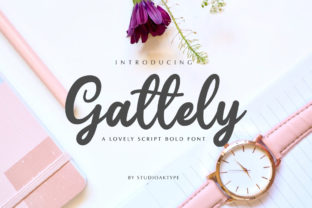
Gattely: A Playful Handwritten Font
Imagine typing a word—and watching it bloom like ink on handmade paper. That’s the feeling Gattely delivers. It’s not just another script font; it’s a carefully crafted, friendly handwritten typeface with gentle curves, natural rhythm, and subtle variation in stroke weight. Each character feels intentional—not overly polished, but warmly human. Whether you’re sketching a logo idea at 7 a.m. or finalizing a wedding invitation at midnight, Gattely brings softness and sincerity to your text.
Why Gattely Feels Different
Unlike many “handwritten” fonts that rely on rigid alternates or mechanical swashes, Gattely balances consistency with personality. Its lowercase letters have a relaxed tilt, its capitals carry quiet confidence, and spacing is tuned for readability—even at small sizes. There are no forced flourishes or distracting ligatures. Instead, it offers quiet charm: a slight bounce in the “y”, a gentle taper on the “t”, a pause built into the flow of “a” and “o”. That makes it unusually versatile—equally at home on a chalkboard-style social post or a minimalist product label.
For Beginners: Friendly First Steps Into Typography
If you’ve ever hesitated to use script fonts—worried they’d look messy, hard to read, or unprofessional—Gattely lowers that barrier. It doesn’t demand mastery of kerning or OpenType features to work well. Drop it into Canva, Figma, or Google Docs (via uploaded font), and it reads clearly right away. Try pairing it with a clean sans-serif like Inter or Lato for contrast: headlines in Gattely, body text in something neutral. That simple combo instantly lifts a blog banner, newsletter header, or Instagram story without requiring design training.
For Educators & Content Creators
Teachers, course designers, and workshop facilitators often need type that feels inviting—not cold or corporate. Gattely supports that goal beautifully. Use it for handout titles, slide headers, or worksheet instructions where warmth matters as much as clarity. One elementary teacher uses it for weekly “Reading Goal” posters; students recognize the font as “our special writing time.” A yoga instructor applies it to class descriptions and reflection prompts—its softness mirrors the tone of her practice. For these users, legibility *and* emotional resonance are equally important—and Gattely delivers both without extra effort.
For Small Business Owners & Freelancers
When your brand voice leans toward approachable, thoughtful, or artisanal—think local bakeries, indie bookshops, ceramic studios, or wellness coaches—Gattely reinforces that identity without shouting. It’s not flashy, but it’s memorable in context. A freelance photographer uses it only for client welcome notes and print captions, keeping everything else typographically restrained. A candle maker pairs it with warm neutrals on packaging labels, letting the font quietly echo the care behind each pour. Here, commercial value isn’t about broad appeal—it’s about alignment. If your customers choose you for authenticity, Gattely helps signal that before a single word is read.
For Designers & Developers
Experienced users appreciate Gattely’s technical thoughtfulness. It includes full Latin-1 support, standard OpenType features (like stylistic alternates and ligatures), and clean vector outlines that scale crisply on any device. No pixelation at large sizes. No unexpected gaps in web rendering. And because it avoids extreme contrast or ultra-thin strokes, it holds up well on lower-resolution screens and printed materials alike. One UI designer uses it sparingly—for microcopy that needs empathy, like error messages (“Oops! Let’s try that again”) or onboarding tips. It’s not for body text—but in those precise moments, its humanity stands out.
What to Consider Before You Use It
Like any tool, Gattely shines brightest when matched to the right job. Ask yourself:
- Is readability at smaller sizes critical? Gattely works best from 16px and up on screen, or 10pt and larger in print. Avoid long paragraphs or fine print.
- Does your project need multilingual support? It covers Western European languages well—but doesn’t include Cyrillic, Greek, or extended diacritics beyond basic accented characters.
- Are you licensing for commercial use? Always check the license terms. Most versions allow personal and commercial projects—including client work—but verify usage rights for apps, merchandise, or SaaS interfaces.
- Do you need tight control over letterforms? While it has stylistic alternates, it’s not a variable font. If you need real-time weight or width adjustments, pair it with a complementary variable sans instead.
Real Projects, Real Decisions
A blogger launching a new newsletter tested three fonts for her “welcome” email subject line. She chose Gattely—not because it was trendiest, but because readers told her it felt “like she wrote it just for me.” A nonprofit creating donor thank-you cards used it for names and short messages, then switched to a sturdy serif for longer impact statements. A student designing her senior thesis cover used Gattely for the subtitle (“A Quiet Study of Light”) while keeping the main title in a crisp geometric type—creating visual hierarchy through contrast, not competition.
Does Gattely Fit Your Next Project?
It likely does—if your goal is to add warmth without sacrificing polish. Not every project needs playfulness, and not every audience responds to handwriting the same way. But if you’re aiming for connection over authority, intimacy over scale, or craft over convenience, Gattely offers something rare: simplicity with soul. It won’t solve layout problems or replace thoughtful content—but it can make good ideas feel more human, and strong voices feel more grounded.
No font is universal. But Gattely comes close to being *right-sized*: generous enough for creativity, restrained enough for clarity, familiar enough to welcome, and distinctive enough to linger.